One of my many obscure interests is in the rhythm and stress patterns in texts, especially in poems and liturgical texts such as hymns, psalms and prayers. Over the past few years one particular stress pattern used when praying the Our Father has intrigued me because when it is combined with the accents of the Midlands of England, it suggests that an important aspect of the Our Father is being missed or misunderstood. If you have a different accent, the pronunciation part of my thoughts below may not mean a great deal, but I hope that the ideas of stress patterns will.
All of this may seem a strange starting point for a religious reflection to take, but please bear with me.
Whether we realise it or not, in spoken English we emphasise certain syllables over others. This is because every text contains stressed and unstressed syllables. When chanting, these syllables become even more important, partly for rhythm and partly because they indicate on which syllables the note will change. This is why the psalms of the Breviary are written out with accents – the accents indicate the syllables to be stressed as one reads or chants. Consider the opening of Psalm 50 (51):
Have mércy on me, Gód, in your kíndness. * In your compássion blot óut my offénce. O wásh me more and móre from my gúilt * and cléanse me fróm my sín.
Below is a recording of this verse being spoken aloud:
And sung to psalm tone 3g, as found in the Liber Usualis:
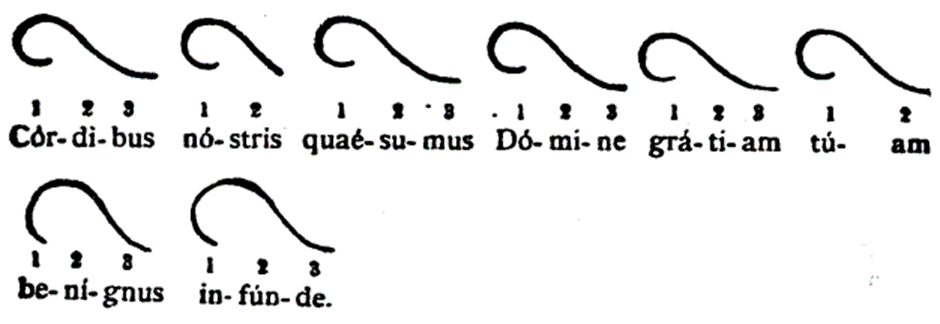
The Liber also contains (in Latin) a simple, yet wonderful illustration of this ebb and flow between stressed and unstressed syllables:
This brings me neatly to the title of this reflection. The word us can be read in two different ways in some English accents. In the Midlands of England, it is often pronounced uzz, with a long ‘z’ sound, rhyming with buzz. Sometimes however it is pronounced uss with a shorter, harder ‘s’ sound, rhyming with fuss; this is less common and usually happens when the word us is itself a stressed syllable, such as at the end of a phrase or sentence.
This may all seem terribly trivial, but consider now the final sentence of the Our Father, punctuated and line-broken as it appears in the Missal:
“Give us this day our daily bread, and forgive us our trespasses, as we forgive those who trespass against us; and lead us not into temptation, but deliver us from evil.”
The Our Father is of course a prayer we say regularly, and it can be very tempting to rattle through such prayers without really considering their words. Although one sentence, the semi-colon at the end of the third line is a clear split between two separate requests: we ask for God’s forgiveness in lines two and three, and then ask him to keep us clear of temptation and sin in the future. As line three ends a phrase and a specific request we should make an effort to pronounce us with a clear, short uss sound; but in haste we are often looking straight to the end of the sentence and resort to the longer and more common uzz sound instead.
On a deeper level, when we are hurrying, we are not fully considering the words we are saying; we don’t take the time to appreciate the ‘us’ in those lines. We are asking God’s forgiveness for the things we do to offend him, but only in the same manner as we forgive those who sin against us. That is a big deal for the Christian life – we are called to forgive as we wish the Father to forgive us. I don’t know about you, dear reader, but I have a great deal I would like forgiveness for; and so I must endeavour to be forgiving in every single situation where someone upsets or hurts me.
Of course, we are not trying to strike a divine bargain with God – he will, in his love, forgive us anything anyway, as long as we show true repentance. But Jesus did not leave us these words in example for nothing; he left them as a guide both for prayer, but also for life. We will live a better, a more fulfilled, and, most importantly, a more holy life if we follow the example of forgiving others who trespass against us.
That is the message which we gloss over and do not take the time to consider every time we rush through an Our Father, all because of a lack of emphasis on a word just two letters long.
It is often pointed out that the character of St Joseph never speaks in the Gospels. His earthly fatherhood is one of silent constancy. Without the words themselves we still see a man of faith, who trusted in the messages given to him by God; and in that faith he was able to love the Lord. There is a great deal of good in his silent example alone, but this Epiphany a connection occurred in my mind between St Joseph and the lesson of the Magi. Credit must go to my school’s chaplain for prompting this connection in something he referred to in his Epiphany homily, 2023.
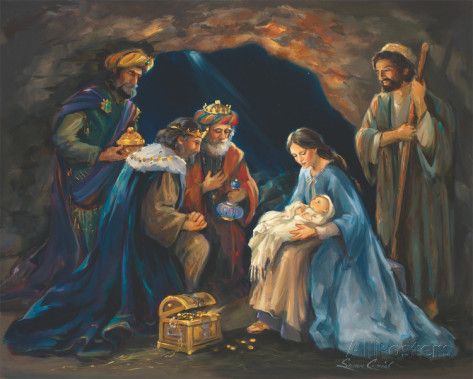
Image: Wise Men Seek Him by Susan Comish
The Magi’s journey would not have been easy for many reasons: the distance; the weather; the dangers of robbery and so on. One of the difficulties not often considered would be language. The Magi were educated men, and when they came searching for the infant King of the Jews they logically went first to Jerusalem. There they conversed with the great and the good; learned scholars who had spent their lives in the study of various disciplines, and of course, King Herod himself. Aramaic was not a widely known language, so it is likely that these conversations took place in a common language such as Hebrew, Greek or Latin, or through court translators. The Magi would have been prepared for this; they would have known how the courts of great men worked, and the etiquette to be followed. They asked their questions and were honest in the answers they gave to Herod’s questions in return. But then they were pointed to a small town south of the city; there would be no scholars or translators there.
And so comes our parallel with the silence of St Joseph. The talkative Magi of Jerusalem do indeed find what they sought. “Going into the house they saw the child with his mother Mary, and falling to their knees they did him homage.” St Matthew puts no words into their mouths now. Perhaps a difficulty of language rendered conversation impossible; perhaps they were struck with a divine awe; perhaps there was an awkward and unrecorded conversation of sorts. Whatever the truth of that visit, St Matthew chooses to recount their visit as an example of silent homage to the Christ-child. They knew that this child was something special. Psalm 111 teaches that “the fear of the Lord is the first stage of Wisdom.” It seems from their visit to Jerusalem that their knowledge of the Jewish scriptures was lacking, but if proof of the Magi as ‘wise men’ were needed, we should have all we need in the way that they fell to their knees in silent wonder.
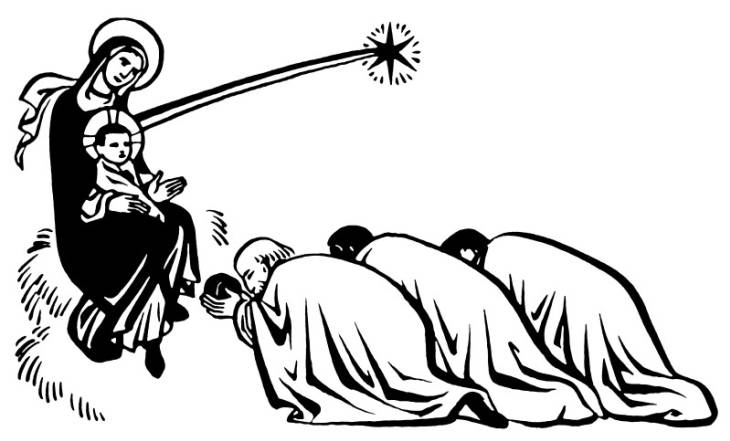
Image: Wise Men Adoring Christ Child by Ade Bethune
From the earliest days of the Church silence has been recognised as a powerful thing. The Lord himself would retreat into the wilderness alone or with his disciples to pray and commune with his Father. John the Baptist, the desert fathers and medieval hermits all recognised that the Lord could be found in the quiet of the wilderness. Contemplative religious orders spend much of their time in silence listening for the Lord’s guidance and praying for the needs of the world without distraction.
Of course for those of us in the secular world, noise is a constant. Sometimes that is external noise: cars, music and conversation around us; but sometimes it is the noise of our own minds, which cannot switch off from the cares and worries of daily life. Fortunately as Catholics we have a beautiful solution to this. Adoration of the Blessed Sacrament, whether at Exposition with the Lord in a monstrance or of the reposed Sacrament in a tabernacle, gives us time to remove ourselves from the noise of the world. Any church provides the respite from the external noise, but releasing our own minds is far more difficult. I do not intend to give a list of exercises for quietening one’s mind in prayer here, but I will suggest that it takes practice, and we should not be disheartened or put off because we find it difficult to let go of our earthly worries the first time, or consistently every time we try.
What we can and really must do, is make the effort. While our internal journey is very different from the travelling of the Magi, it can seem just as difficult. What we can be assured of however, is that it has the same end; to offer our true and complete homage to the one Lord and Saviour. We can be sure that whenever, and however often we come to him, the Lord will be waiting for us: “Jesus Christ is the same yesterday and today and forever.”
Today we keep the octave day of Christmas, which in the Church’s calendar is given to Mary as the Mother of God. This title is very simple to say, but is arguably the most significant out of all of those given to Mary; so much so that it caused much discussion in the early Church.
Many of you will know that I am something of a pedant, and I will happily have an hour’s discussion over the use of a single word or comma. I suspect therefore that I would have greatly enjoyed the Council of Ephesus, at which two great characters of Church history battled it out over a single word. On one side was a character called Nestorius, who argued that Mary’s motherhood was simply linked to the humanity of Christ; so, without disrespect, she should at best be considered the Mother of Christ. On the other hand was St Cyril of Alexandria who pointed out that as Christ’s humanity and divinity cannot be separated, Mary was not only Mother of the human Jesus, but the Mother of God, in all his divinity.
As you can tell from the name of today’s Feast, and his sainthood, St Cyril won the argument, and Nestorianism was declared a heresy in the Church. This is why today the universal Church recognises the mother of that tiny child in the manger as the Mother of God; the same God who spoke to the patriarchs and prophets; the same God we hear speaking to Moses in our first reading.
St Paul tells us today that it is through the incarnation of Christ that we have all become adopted as sons and daughters of God. That of course means that we have become Mary’s children too. This does not in any way equate Mary with Almighty God, as some protestants would suggest. We revere Mary for her role as the first believer in, and the first adorer of, the Christ-child. In this she is the perfect image of all believers, but just like all believers her own salvation comes only through the grace of God.
But it is not Nestorian to remember also today the normality of Mary’s role in the childhood of the Lord. Jesus was God, but he was also a defenceless child. He had his mother, Mary, and his earthly father, Joseph. They loved him, and cared for him, and raised him; in a very normal and human way.
In the run-up to Christmas, I was lucky enough to go into one of my parish’s schools and decorate a Bambinello with my son. That baby is now in our nativity scene at home, where it will stay until Candlemas. After that it may be put away with the Christmas things, or it might go into his keep-sake box.
I suspect most families will have, somewhere in their house, a keep-sake box for their children. A gradually expanding collection of school reports, certificates and artworks. As important as they are, these physical objects hold value to us for the occasions that they bring to mind. Opening that box is a way of remembering those memorable times, some of which we might otherwise have forgotten.
The most important occasions, of course, it would be impossible to forget even if we tried. For those of us who are married, our wedding day is probably one. For those who are parents, the days of our children’s births will be others. Of course, such events may not always be positive; the loss of a loved one or the discovery of an illness can be just as memorable, albeit in a very different way.
Memories though, however vivid, are only ever in our minds; to truly reflect on them, on emotional and spiritual levels, we must use our hearts. This is what St Luke means when he says that Mary ‘treasured these things and pondered them in her heart.’ She knew that what was happening in that stable of Bethlehem was important. It was life-changing for her, as any mother knows, but it was more than that. This child was going to change the world. How, she did not understand; but her ‘fiat’ went far beyond simply carrying and birthing this child that an angel had called the Son of God; she was now the mother who would raise him. Theologians’ arguments aside, she was – and she knew she was – even in that humble stable, the Mother of God.
Some people prefer a sanitised view of the Christ-child and Mary’s care for him. The child described in the carols: ‘Christian children all must be, mild, obedient, good as he.’ The reality however must have been different: Christ embraced our humanity in everything but sin; so how did he tell Mary that he was hungry, or that his nappy needed changing? He would have cried, like any baby. How did he grow and learn all the things that everyone has to learn? He learned by asking his mother.
In contemplating this normality of the Lord’s upbringing I was reminded of a Catholic cartoon which goes around every so often on the internet with the title ‘Jesus prays the first rosary,’ or similar. The image shows a young Jesus looking up at Mary and tugging at her skirts while repeating over and over ‘mum, mum, mum, mum, mum…’ A very normal thing for a lot of mothers and their children.
[For those reading online a copy of this image is below]
We are the spiritual children of Mary, so we should have no fear of turning to her in our need just as the child Jesus did. And yes that means sometimes being that child and repeating ever more fervently ‘mum, mum mum!’
I think it is right today to finish by asking our Lady, our heavenly mum, to lead the saints and angels in intercession for the repose of the soul of dear Pope Benedict.
Mother of God, all Saints of God, come to his aid; Hasten to meet him, angels of the Lord. Receive his soul and present him to God, the most high.
“For what greater grace could have dawned upon us from God, than that him who had only one Son, made him the son of man, and so in turn made the son of man a son of God. Ask yourself whether this involved any merit, any motivation, any right on your part; and see whether you find anything but grace!”
These are the words of St Augustine of Hippo in the Office of Readings for Christmas Eve. As we draw at last to the end of Advent, St Augustine invites us to consider the why of Christmas.
The Adoration of the Child is depicted in this 17th-century painting by Dutch artist Gerard van Honthorst.
The first sentence of that quote can seem quite bewildering, but it is a rephrasing of the fundamental Christian reality: God sent his only Son into the world as a man, to redeem all of mankind to himself. In the words of St Paul in his letter to the Galatians: “God sent forth his Son, born of a woman… so that we might receive adoption as sons.” The Nativity of the Lord which we are about to celebrate is the beginning of this mystery; the Son coming to earth. We must of course wait until the Easter Triduum to celebrate its terrible and glorious fulfilment in the Passion, Death and Resurrection of the Lord.
This is the root of our faith, but as St Augustine points out, we must ask why? Psalm 8 asks just this question of the Lord: “What is man that you should keep in mind, mortal man that you care for him?” What has mankind done to warrant the coming of our God to earth, on that first Christmas, or this one, or any in between? St Augustine offers us an answer in a roundabout way:
Nothing.
Even if the world had the united will to earn salvation, to earn the presence on earth of our Redeemer, there is not enough wealth in the world to buy his favour. From the Lord’s perspective in Psalm 49 (50): “If I were hungry, I would not tell you, for I own the world and all it holds.” In short, there is no thing that we can offer to God.
So what can we offer, if not things? That same psalm gives us an answer: “Pay your sacrifice of thanksgiving to God… a sacrifice of thanksgiving honours me and I will show God’s salvation to the upright.” Many of us will sing the carol In the Bleak Midwinter over the coming days; the final line of that hymn gives us the same answer: “what I can I give him; give my heart.” The sacrifice which the Lord asks of us is our heart-felt love. It is by loving him that we will find salvation, and that begins tonight, with the remembrance and celebration of a helpless child, born to humble parents two millennia ago.
St Augustine challenges us one last time with his final words. We can and should make the free choice to worship God; but he did not come as our Redeemer in repayment for love which had been given, nor to leave us in his debt, with love to be offered later. He came because he loves us, and with a more perfect love than we can imagine. In his love God showers us with graces of all kinds, but none more so than that which began in a stable of Bethlehem, with the child named by St Gabriel as Emmanuel – God-with-us.
Mankind did not, and does not, deserve what St John called the “love the Father has given us, that we should be called children of God.” When we truly consider the mystery of the Incarnation which we are about to celebrate, can any of us “find anything but grace?”
For many years, as a child and an adult, I found hope to be the most difficult of the theological virtues. I could accept the role of faith in my life, and the need for charitable love was always evident, but an understanding of hope always alluded me. At its best it seemed a different form of faith – we trust that God will give us what we need, when we need it, therefore we do not need to hope if we have faith in the Lord’s goodness. At its worst, it seemed sinful – it is possible, even easy, to hope for things which are most definitely not good for us.
In my Advent reflections over the years I have come to appreciate the example of John the Baptist as a person of hope. This is an example which we should all seek to follow, for it is one of selfless hope. When we know something that others do not, we are often tempted to keep this knowledge as our secret, or to drip-feed it to gain other people’s interest in, and even acclaim for, the gossip that we have to share. The knowledge of Christian hope must not be like this. Rather, it’s sharing is like passing the light from a candle. We lose nothing in the sharing – our light, our hope, burns as brightly as ever. In fact, we are now one among a pair, a dozen, a hundred beacons of hope; which together light up the darkness of our world more and more, as we share the hope we have in Christ.
An ancient writer, Origen, wrote that he believed “the mystery of John is still being fulfilled in the world, even today.” John’s mystery is now the Church’s mission. We pass on the light of hope in Christ to those around us, and in this we can have no greater model than John, whom Christ himself acclaimed: “of all the children born of women, there is no one greater.”
The paradox of Christian hope is that our hope has already been fulfilled. We know the end to which the light of our hope leads us. We are destined for a heavenly home if we will but take up our cross in this dark world, and follow him who is the Alpha and the Omega, the beginning and end of all things. In this he is the embodiment of Christian hope, and with that in mind I will finish with the words of St John Henry Newman’s hymn:
Lead kindly light, amid the encircling gloom. Lead thou me on. The night is dark, and I am far from home. Lead thou me on.
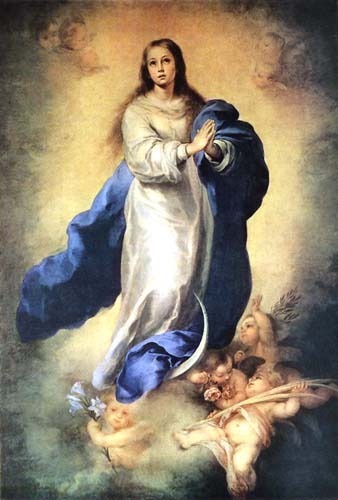
When Pope Pius IX defined the dogma of the Immaculate Conception of the Blessed Virgin Mary (Ineffabilis Deus, 1854), he was enshrining for all time a belief which had already been held for well over a thousand years.
The biggest misconception (no pun intended) regarding the Immaculate Conception is to confuse it with the Annunciation. Today’s feast refers to the conception of Mary herself, not the conception of Christ as announced by the Angel Gabriel. It may seem that the choice of the Annunciation as today’s Gospel is a curious choice then; surely it will just encourage confusion. However, as we will see, that beautiful interaction tells us not just about Mary’s future, but also reveals something crucial about her past.
Mary’s conception and parentage are not described in the Gospels (though ancient tradition gives her parents’ names as Joachim and Anne, whose feast day is the 26th of July.) What we know of Mary from the Gospels is that she became the Theotokos – a Greek term usually translated as ‘God-bearer’, or more familiarly, ‘Mother of God’. Neither of these translations quite do the term justice however; because the first implies that Mary was simply a tool which God used, in the way one would ‘bear’ water in a jug, whilst the second emphasises the humanity of Christ over his divinity. To the early Church, the term Theotokos referenced her privileged role, whilst emphasising the combined humanity and divinity of the person of Christ (the ‘hypostatic union’.)
That last sentence sums up how we should consider Mary’s example, and to a lesser extent all of the saints. We refer to them in order to emphasise aspects of the God we worship. We consider their example and ask their intercession in order to bring ourselves closer to God. In our Lady’s Immaculate Conception we see the infinite goodness of God as salvation history approached its high point in the Incarnation, and ultimately the Death and Resurrection, of the Lord.
The first reading at Holy Mass today is the account of the sin of Eve and the consequence of Original Sin for all of her descendants. It is easy to see in this passage the vengeful God one often expects of the Old Testament, but even here God shows his immense love and his ultimate plan for salvation. Both Jews and Christians see in this passage the first prophecy of the Messiah:
“I will make you enemies of each other: you (Satan) and the woman (Eve/Mary), your offspring (sin and death) and her offspring (Christ). It (Christ) will crush your head and you (sin and death) will strike its heel.”
The place of Mary, the new Eve, in opposing Satan in a way which the original Eve could not, dates back to at least St Justin in the mid-second century. So what set Mary apart from Eve, and indeed every other woman ever born? For the answer to this we must refer to today’s Gospel, and arguably the most commonly spoken Christian prayer.
The word angel means ‘messenger’; they speak on behalf of God. In greeting Mary the Angel Gabriel said, “rejoice, so highly favoured! The Lord is with you.” Perhaps a more recognisable translation would help: “Hail [Mary], full of grace. The Lord is with thee.” It is a shame, in my humble opinion, that the translation used in the Lectionary varies so much from the Latin and Greek here: ‘gratia’ should clearly be translated as ‘grace’; and ‘ave’ is a greeting, not a suggestion to ‘rejoice’. The original Greek makes this even clearer: it uses a verb meaning ‘endow with grace’ (κεχαριτωμενη/kecharitomene) in the perfect and passive, which means that the Angel did not bestow God’s grace upon Mary there and then, but that she had always had the graces needed to lead her to this point and those needed to fulfil her role from this moment onwards. Our answer then is that Mary was possessed of graces that no other human, before or since, has been given. This is what we affirm every time we say the Hail Mary: She was truly full of grace.
While the Council of Trent (1545-63) had acknowledged that Mary was graced with a life free from sin, Pope Pius IX clarified the Angel’s words as meaning that Mary was also free from the Original Sin caused by the sin of Eve. This immaculate nature – an existence without stain or blemish, was necessary for her to be the Ark of the New Covenant, the Mother of God, the Theotokos.
John the Baptist has been a sadly under-rated saint in recent times. He was in his father’s words as recorded in Luke’s Gospel: “a prophet of God the most high,” he “went ahead of the Lord, to prepare his ways before him.” He was the fulfilment of part of the prophecy of Isaiah – the voice which cries in the wilderness, “prepare a way for the Lord, make his paths straight.”
An ancient hymn of John the Baptist called Ut Queant Laxis contains a wonderful musical nod to his role as the fore-runner of Christ. Each successive phrase in that hymn begins a note higher than the last, escalating higher and higher, just as the scriptures see John the Baptist being the sign to something higher than himself – the Lord who was to come.
For the musicians among us, that same hymn is the origin of the solfege scale made famous by the Sound of Music – do, re, mi, fa, sol, la, ti, do. Perhaps take a moment to remember St John the Baptist over Christmas if you find yourself one afternoon watching the inevitable showing of Julie Andrews and the Von Trapp children prancing around an Alpine meadow.
We should see John the Baptist as a great prophet and saint of the Church. And in him we should see an example to us in our day. When you think of when you imagine the wilderness in which John lived? What do you picture? What comes into your mind’s eye? Perhaps a desert or a vast empty plain. More important than the image – is anything happening there? Probably not. Perhaps at most a whisp of sand blowing in a breeze or a camel baying in the distance?
But in truth the wilderness of the holy land is not a calm and peaceful place. It gets extreme heat in the day and cold in the night. Strong winds drive sandstorms that will scour the skin. There is a real danger of starvation or thirst. There are animals that will kill you; some obviously, like wolves, others subtly, like snakes and scorpions. Yet despite all this John managed to live a good and upright life.
Our secular world is very much a spiritual wilderness, and like the literal wilderness of John the Baptist there are many threats to our living good and upright lives:
Individualism – seeing ourselves above all else.
Materialism – seeing possessions as the most important thing in life.
Consumerism – finding happiness almost exclusively in the purchase of goods.
We can all see some of these things in ourselves at times, I’m sure; and it is very easy to get caught up in them as we get ready for the Christmas festivities. Of course, it is right to celebrate the Incarnation and keep the great feast of Christmas as a joyful occasion. But in the next few weeks as you prepare for those celebrations, also remember to follow the example of St John:
Do not be afraid to be a voice that cries into the spiritual wilderness of our world. Do not be afraid to tell people of Christ, of the real meaning of Christmas, of his death and resurrection, of the redemption of the world. If we all do this, proudly and fiercely, then truly, in the words of Isaiah, “all mankind shall see the salvation of God.”
This is a somewhat longer than normal post, as it is a response to a question I was asked earlier this week about how often it is right to receive Holy Communion. The question was asked by a man who currently goes to daily mass, but usually only receives on a Sunday. His reason for this being that he feels that he doesn’t always have time to make an honest thanksgiving after receiving at a weekday mass.
His question spurred me to some reading on the changing practices of the regularity of Holy Communion over the years and some prayer and reflection on the practice as it exists today in Western Europe. What follows is a summary of my thoughts and an attempt to give a considered opinion on how one might view regular and daily Holy Communion.
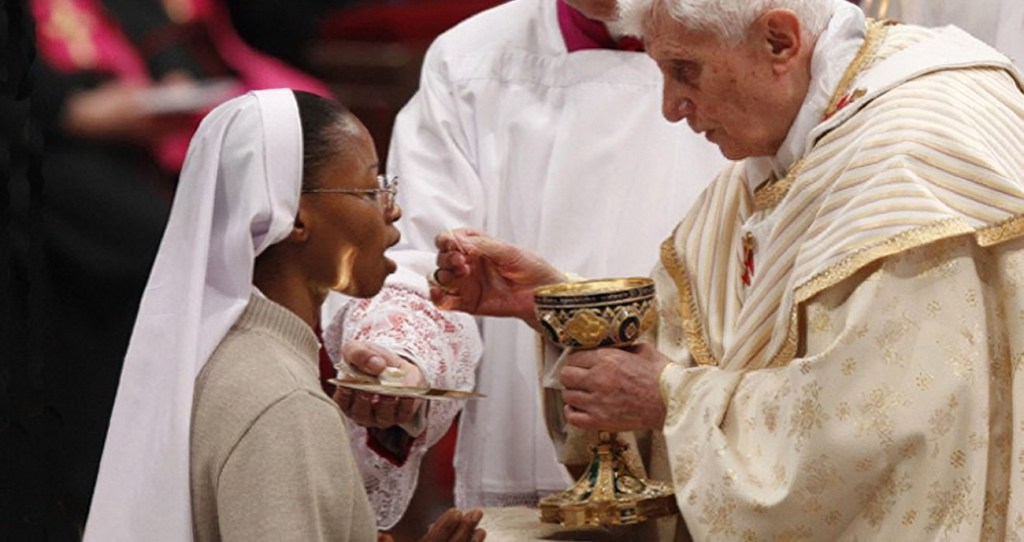
Let me begin by stating clearly and unequivocally: We should attend Holy Mass and receive the Lord in Holy Communion as often as we are able to. The Blessed Sacrament is our God made present: Body, Blood, Soul, and Divinity; and Holy Mass is the highest form of prayer and praise that we can be part of this side of heaven. However, as we shall see, being able to is not synonymous with simply having the opportunity to.
In the scriptures there are implications that the early Church in Jerusalem received daily, but they are open to some interpretation. For example, Acts 2:46 describes the faithful meeting every day in the temple courts, but leaves it to the next sentence to say, “they broke bread in their homes and ate together.” This is describing the very early origins of the Sacrifice of Holy Mass but is removed in language from the daily gathering in the temple. Later in Acts (20:7), Paul describes coming together with the young Church at Troas “on the first day of the week… to break bread;” but again, it is unclear whether they only did this once a week, or more regularly.
The Fathers of the Church seem to be divided; the Didache and St Justin point to only receiving on a Sunday, whilst St Cyprian, St John Chrysostom and St Ambrose are among those who describe daily communion as a common occurrence. Many of the Fathers are neither supportive of nor resistant to daily communion. St Augustine simply decribes that “some receive the Body and Blood of the Lord every day… others on Sunday alone;” while St Jerome writes, “of [daily communion] I neither approve nor disapprove.”
Regardless of the practice in the early Church, what is clear is that by the Middle Ages receiving Communion had become very rare amongst the laity, to the point that the Fourth Lateran Council (1215) introduced for the first time the obligation of all the faithful to receive Communion at least once each year (in Lent, rather than the current Eastertide discipline.) The reasons that reception became so infrequent are complex and a matter for historical scholars, and there is not time to discuss them at any length here; but if we consider that mass attendance in the Middle Ages was very high in Western Europe, it does leave us with a relevant question: Why did people go to mass if they were not going to receive the Lord in the Blessed Sacrament itself?
For many, in fact probably most, Catholics, attending Holy Mass comes with an expectation of, even a sense of entitlement to, Holy Communion. Communion is a part of Mass therefore I will receive Communion. This is not the case, and is something that I believe needs challenging in the modern Church for a number of reasons:
Firstly, it leads to an expectation that everyone gets up and approaches the altar, even if only for a blessing. God’s blessing is given to all present at the end of Mass by the celebrant; there is no extra holiness to be gained by receiving a personal blessing five minutes earlier in the Communion queue. However, in the interests of inclusion and dare I say ‘active participation’ I will say no more about Communion blessings here.
Much more significantly, an expectation of Communion removes in our minds the necessity of considering our suitability to receive the Lord in his Eucharistic Body. At school masses I have heard it said, “if you are not Catholic, or are Catholic but unable to receive Communion, then please come forward for a blessing.” I have asked many Catholic teenagers after such statements if they knew what would make them “unable to receive Communion,” and the vast majority (95% and more) have no idea. I strongly suspect a similar reaction would be given by most adult Catholics today, certainly in Western Europe and North America. This almost blasé approach to our state of grace has gone hand-in-hand with a decline of our awareness of sin and the infrequency with which most Catholics now seek the Sacrament of Reconciliation (Confession).
So what were the medieval faithful getting spiritually from Mass if it was not Holy Communion? They understood that at Mass they came into the presence of the Almighty, the Holy of Holies. They knew that, to use a traditional term, they assisted at Mass, uniting their prayers and needs to the Sacrifice offered by God’s holy priest, standing in the place of their Lord and Saviour. It is easy to look down on the faith of medieval peasants and see them as a mass of religious illiterati, but while their faith may not have been educated in the modern sense, it was deep enough to keep them seeking the tranquillity and numinous beauty of Holy Mass, even if they did not receive Holy Communion every time. If we do not find the same beauty that they saw, then there is something wrong. Perhaps this can be put down to the nature of the modern liturgy, or at least its expression in certain places, but I suspect it has far more to do with our own approach to Holy Mass and our role within it. The doctrine that the faithful unite themselves and their prayers with the Sacrifice offered by the priest who stands in persona Christi has not gone away. With our vernacular liturgy the words are even there for our well-educated modern minds to follow, if we care to, and I can do no better than to quote them. Anyone and everyone reading this reflection would do well to consider and personally reflect upon the beautiful dialogue between priest and people immediately before the Prayer over the Offerings:
We stand as the priest addresses us:
Pray, brethren, that my sacrifice and yours may be acceptable to God, the almighty Father.
And we reply:
May the Lord accept the sacrifice at your hands for the praise and glory of his name, for our good and the good of all his holy Church.
One of the documents of the Council of Trent (1545-1563) stated for the first time in centuries that “at each mass, the faithful who are present should communicate.” In contrast, if not contradiction (given that the weekly Sunday obligation had existed in practice for well over a millennium), the catechism of that same council states that while regular communion is a positive thing, “whether it be monthly, weekly, or daily, can be decided by no fixed universal rule.” This certainly leaves the door ajar for regular, even daily, mass attenders to receive as and when they feel able.
In the most definitive document of our time, a decree given at the instruction of Pope St Pius X (Sacra Tridentina, 1905) quoted the Council of Trent in encouraging Holy Communion “as often as possible, even daily.” This quote, in isolation, would seem to encourage the cavalier attitude described above, and gives little regard to whether a person is in a state of grace. This could not be further from the truth. The second part of the decree gives numbered points in regard to the practice of daily Communion, and I will give the second of these points in full:
“A right intention consists in this: that he who approaches the Holy Table should do so, not out of routine, or vain glory, or human respect, but that he wish to please God, to be more closely united with Him by charity, and to have recourse to this divine remedy for his weakness and defects.”
The next (third) point specifically requires that communicants “be free from mortal sin;” and the final (ninth) point insists that there is to be no more “contentious controversy concerning the dispositions requisite for frequent and daily Communion.”
If we combine these together, we appear to reach a definitive conclusion: As long as one is in a state of grace (id est, free from mortal sin), and is receiving with the intention of coming closer to God, then one should receive as often as possible, even daily.
I turn now to my own interpretation and humble opinion.
Let us be in no doubt – the Lord wants to come to us in Holy Communion. In the words of St Therese, “Jesus does not descend in order to live in the tabernacle, but he wants to dwell in our souls.” In preparing my daughter (who is named for Therese) for her First Holy Communion I read her the passages from The Story of a Soul (Therese’s autobiography) which describe the joy that the Saint felt as she received the Lord for the first and subsequent times. In those passages, Therese shows great devotion to the Lord in Holy Communion, and laments that she cannot receive more often: “my one desire was for Holy Communion, which was allowed to me on all the great feasts. Alas! how far apart they seemed!” No doubt Therese was prepared and well-disposed for those occasions when she received the Lord; we are called to feel that same desire. We mustn’t see the saints as unobtainable and unrealistic ideals – there is nothing to stop us feeling the same devotion as St Therese except our own selves. Remember, the Lord wants to come to us, do we truly want him?
We are blessed in our part of the world and our time that we have regular local Mass, and readily available transport to get us there. There have been many occasions in the history of the Church when this has not been so; consider the early persecuted Church, recusant England, Soviet gulags, the oppression seen in Africa and China today. I think particularly of a story told to me by a parishioner (and who has given her permission to share this anecdote) who described living in Saudi Arabia fifty or so years ago. Being a priest was illegal and often they would go months without one visiting. When a priest did come, clandestine Masses were said in private houses and the Blessed Sacrament was reserved with great secrecy in a person’s home. Whilst I admit I found the image of her genuflecting each time she passed her freezer rather amusing at first, in that situation we cannot help but consider the Blessed Sacrament for what it really is. Simply being caught with it would have seen that lady and her husband sent to prison, yet they took the risk so that our Lord could be present in that place and be brought to those who needed him. Do we consider Christ in the same way as shuffle forward in the queue at every Mass we go to? Or do we sometimes take Holy Communion for granted?
No one can judge whether in their heart a person presenting themselves for Holy Communion truly seeks to come closer to God, perhaps least of all the minister administering the Sacrament. Leaving aside the controversies of those in public and manifest grave sin such as have enveloped the Church in the United States, if a person comes forward for Holy Communion, then it should be given. The judgement should be made by the communicant themselves. However, for that judgement to be genuine, the faithful must be aware, and indeed in awe of, that which they are approaching, and what exactly it is that they are asking for. Again, this could not be plainer in the Ordinary Form of the Mass, if we care to consider the words used. Literally, “the Body of Christ;” to which we affirm, “Amen,” it truly is.
Personally, I do not always receive the Blessed Sacrament at Holy Mass, and I do not consider myself scrupulous for admitting to myself, upon examination, that I am not in the right state of mind to receive my Lord in that way today. If I truly believe myself to have fallen from a state of grace through mortal sin then I avail myself of Confession as soon as I possibly can, and this has been in the sacristy minutes before Mass. Far more commonly though I feel rushed in my preparation; or distracted during Mass by other things I have to do; or annoyed at something that has happened that day. I still do my best to assist at that Mass; to unite my prayers to those of the community and to the Sacrifice of the Mass. I still leave with a sense of fulfilment, knowing that I have spent time with my Eucharistic Lord and have drawn closer to him than when I walked in. In that regard it perhaps feels similar to attending Adoration.
The essence of this is that if we consider ourselves able to receive the Lord at any particular mass, then we should. It is not about being worthy, because no one is worthy of the love that Christ showed when he gave us his Body and Blood in the Eucharist; but we can decide for ourselves whether this is the right time to unite ourselves with the Lord in that most perfect way. If we receive by habit or routine, or when we feel distracted or rushed, or if we doubt our state of grace, then we offer our Lord nothing but human contempt in return for immeasurable love.
I do not share these thoughts in an attempt to dissuade people from daily Communion. Quite the opposite in fact. If in reading this you are truly upset at the thought of going without the intimacy of Holy Communion, then be happy, because your love and desire for the Blessed Sacrament has a depth that I fear many of the faithful today lack. If, when you examine your own heart, you see something of yourself in the routineness or distraction I have described, then consider kneeling in silent prayer during communion at just a single mass. Your yearning for our Eucharistic Lord will grow and you may find yourself spurred to a true conversion of heart in an aspect of life that has kept you from coming closer to God.
At the very least I would encourage everyone to an honest and rigorous examination of oneself before every Mass; and if we find ourselves lacking, offer up whatever it is that is keeping us from the Lord that day and recite the prayer of the Centurion through and through in our minds:
Domine, non sum dignus ut intres sub tectum meum, sed tantum dic verbum, et sanabitur anima mea.
Lord, I am not worthy that you should enter under my roof, but only say the word, and my soul shall be healed.
All of my family either love, or have at some point loved, the children’s toy Lego. A few years ago, my wife and I took our children to Legoland Windsor to stay for a night in one of their hotels, as part of my daughter’s birthday celebrations. We didn’t tell the children where we were going or what for; we just bundled them into the car not long before dawn and headed off on the motorway. As we drove, the slowly lightening sky gave way to dawn and the children’s eagerness for the adventure grew. We kept the secret right up to the moment we pulled into the park and saw the sign topped by giant Lego bricks. At this point there was smiling and bouncing all round in the back seat, and as those who are parents will know, there is nothing better than seeing unadulterated happiness on the faces of your children. It was a very, very good trip.
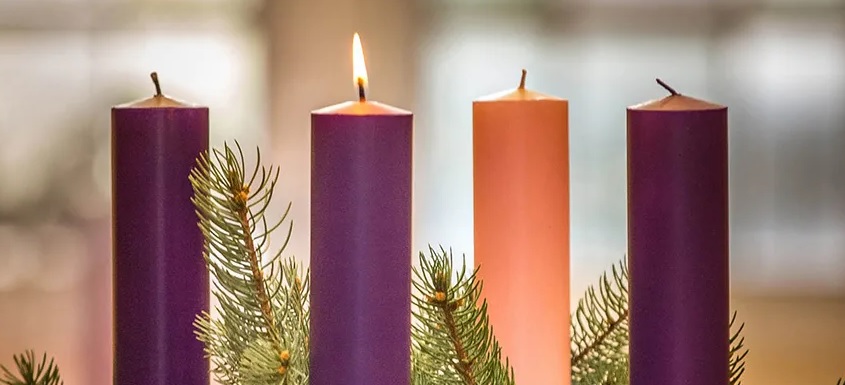
That trip began a new year of my daughter’s life. Today, the First Sunday of Advent, we open a new year in the life of the Church. We begin in a similar way – we have been roused in the darkness and started onto our Advent journey. In the words of our second reading, ‘the night is almost over, it will be daylight soon.’ Nowhere is this beautiful analogy of darkness giving way to light clearer than in the Rorate masses of Advent. If you have the chance to attend one or more of these masses this Advent, I strongly recommend them. They take place in the darkness immediately before dawn, and if timed right one enters the church in darkness, with candles often providing the only light, and then leaves into the brightness of the winter’s morning.
Unlike the children though, we know the wonderful end of our journey: Christmas, certainly, and our great commemoration of the Incarnation; but in these first weeks of Advent, we consider in a particular way the coming of the Lord at the end of time. Our Gospel contains stark language from Jesus: ‘of two men in the fields one is taken, one left; of two women at the millstone grinding, one is taken, one left.’ Jesus is not suggesting a fifty-fifty split; he is explaining that there will be a suddenness to his return.
There is an old episode of the Simpsons, in which Bart explains to a minister that he was hoping to live a life of sin followed by a ‘presto-chango death-bed repentance.’ The minister argues that living a good life means he receives ‘full coverage’ in the event of a sudden death. It is the Simpsons, so it is all a bit blasé; but this is what we seek when we pray to avoid ‘an unprovided death.’ We are called in our Gospel and second reading to seek the ‘full coverage’ of a holy life, not just to avoid an unprovided death, but also to avoid being unworthy should the Lord return during our time on earth.
It is no secret that the early Church expected the Lord to return imminently – there is a satirical religious cartoon which portrays the Apostles running a book and taking bets on the date that the Lord will return before his feet have even disappeared into the clouds above them. The word imminent is an interesting one – its origin comes from a Latin word (mineo) which means to project over, or to overhang. The same root gives us the English word menace. In a sense the return of the Lord is menacing – it will come ‘at an hour [we] do not expect;’ and if we are not ready then yes, we should be concerned about that. But we can be prepared for it.
We can be Baptised; receive regular absolution in the sacrament of Confession; we can be with the Lord personally in Holy Communion and at Adoration. In the words of the Penny Catechism, the sacraments are ‘outward signs of inward grace.’ It is the graces received from the sacraments that allow us to ‘live decently,’ as St Paul describes it. We can put on the armour of Christ and bring about the world that Isaiah describes in our first reading; a world where ‘all the nations will stream… to the Temple of the God of Jacob.’
The first part of Advent is not seeking to cause an anxiousness in the faithful. It encourages us to reflect on what is really important as a Christian: our relationship with the Lord. To foster in our hearts his message and his promise to us; that we will one day ‘walk in the light of the Lord’ if we will but take up our cross and follow him.
As we begin this journey through the darkness of Advent, our anticipation and excitement will rise as we approach the celebration of the Incarnation. Let us also remember that we are journeying to the Lord’s second dawn too. As we make our worldly preparations, let us always conduct ourselves in such a way that we need have no fear of that day.
Collect from Mass on the First Sunday of Advent:
Grant your faithful, we pray, almighty God, the resolve to run forth to meet your Christ with righteous deeds at his coming, so that, gathered at his right hand, they may be worthy to possess the heavenly kingdom. Through our Lord Jesus Christ, your Son, who lives and reigns with you in the unity of the Holy Spirit, one God, for ever and ever.
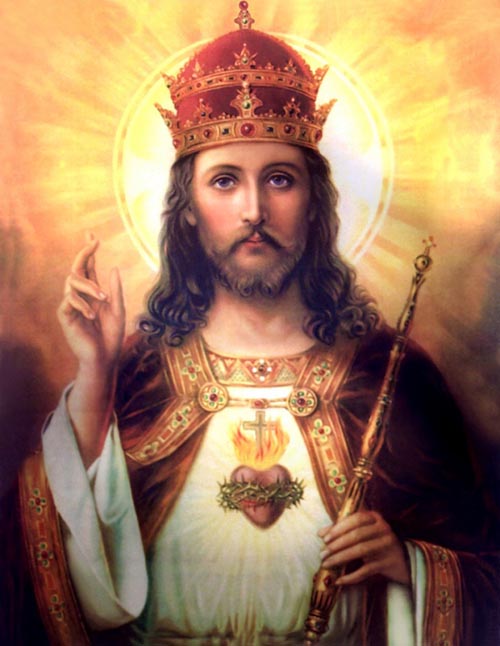
The words Christus vincit, Christus regnat, Christus imperat – Christ conquers, Christ reigns, Christ commands, are carved into the obelisk which stands in St Peter’s Square in the Vatican. That obelisk was placed there by Pope Sixtus V in 1586 as an eternal memorial to Christ the King.
Obelisks carried connotations of the divine from their earliest days. To the Egyptians the shape of what they called a tekhenu was reminiscent of the benben – the mound on which their creator god stood during the creation of the world; the living deity that was their Pharoah, and curiously, a bird which represented both the beginning and end of the world. Today’s second reading makes it clear that the Lord is eternal; “before anything was created, he existed.” He will be there too at the end of all things, the Lamb of St John’s Revelation. The Lord is the living God, “consubstantial with the Father” in the Holy Spirit. As such he is the fulness of revelation and the aim of human faith.
To the later Romans the Egyptian obelisks took on a different meaning. They were removed to Rome and erected as monuments to the victories of the god-emperors. The obelisk which stands in the Vatican carries an echo of this meaning even to this day. It was first transported to Rome by the emperor Caligula and placed outside the great circus he had built on the site where St Peter’s Basilica now stands. When it was moved in the sixteenth century to its current position it was exorcised and blessed as monument to Christ’s victory over even the most influential secular powers.
Today’s Gospel may seem an odd choice for today’s feast; but it has two important messages for us as we consider the sovereignty of the Lord. Firstly, it reminds us that Christ’s kingship extends far beyond what we can understand. His promise to the good thief that “today you will be with me in paradise,” is more than a promise of heaven. It shows the Lord’s authority to promise heaven. Anyone can say the words of a promise, but without the power to fulfil that promise, it remains only words. As Christians we take the Lord’s authority to fulfil his promise as an essential part of our faith – he is the Word made Flesh, Truth Incarnate; in the words of a hymn by Thomas Aquinas, “Truth himself speaks truly, else there’s nothing true.” Christ’s authority then, extends not just to the miracles and wonders he worked in our world, but unto the end of time and beyond, to the paradise which awaits all the faithful.
Secondly, the crucifixion is given to us today as a reminder that all authority in heaven and on earth has been given to him precisely because of the Cross. Even as mankind committed deicide, the greatest of sins, he felt nothing but love, offered nothing but redemption. His is not the kingship of a tyrant, ruling by fear and oppression, but one of charity and benevolence. As Catholics we understand every mass as making present the sacrifice of the Cross; at each Eucharist the Lord comes to us as his Body and Blood. As we attend mass this Sunday and behold the elevated host and chalice, let us share in the prayer of the good thief, “Jesus, remember me;” and be assured that in his divine majesty, he will.




 Lk 22:27