
Audio Recording:
Text:
The relationship between Christmas and today’s Feast of the Epiphany is complicated, but despite the appearance of wise men in many nativity plays, it is important not to fall into the trap of thinking that it is simply an extension of the Christmas story. In fact, in a very important way, Christmas and the Epiphany can be seen as opposites to one another:
Christmas emphasises the humanity taken on by the divine godhead in coming into the world. What could be more human than the tiny, helpless babe of Christmas night? Epiphany on the other hand reveals the divine nature of that child and the man he grew up to be. Adoration, sacrifice, miracles – these are things associated with God, not a human person. Even the word Epiphany means a revealing or an appearing. Today we are seeing the Christ-child in a new light. Christmas showed us the human baby Jesus, Epiphany unveils the Son of the God, the second person of the Trinity.
The readings today put the emphasis very much on the Magi who came to Bethlehem, but Sacred Tradition gives us three revelations to consider: The Magi, certainly; but also the Wedding at Cana, where Jesus revealed his divine power through the miracle of water being turned into wine; and the Baptism of the Lord, at which the three parts of the Trinity are revealed together.
At 12 noon: If you pay particular attention to the words of the first two verses of our offertory hymn you will see the emphasis placed on these three events.
But as today’s liturgy focuses on the revelation offered by the Magi, let us see what we can discern about them. The short answer to ‘what can a group of two thousand year old astronomers teach us about the Christian life?’ is simply ‘everything.’ But perhaps we should dig a little deeper into two aspects of this mystery.
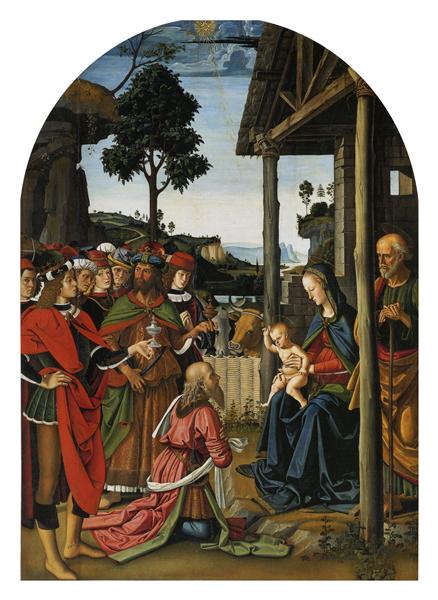
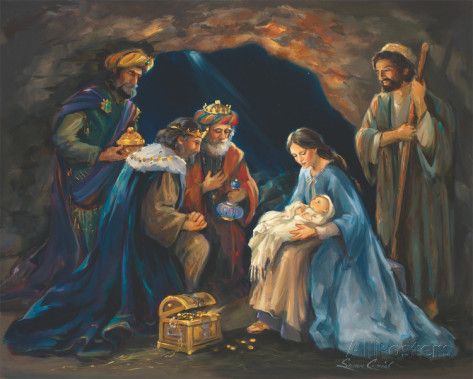
One of the running themes through our readings is that of light: The first reading is a great prophecy of Isaiah: Arise, shine out, Jerusalem, for your light has come. The Gospel tells of the famous star that filled the Magi with delight. This light is a symbol of divinity, and it leads the Magi, eventually, to the humblest of circumstances. When they arrive and go into the place where the child is, we get none of the displays of knowledge or the talkativeness that they displayed back in Jerusalem. They know that they are in the presence of the divinity that the star was leading them to. They simply and silently fall to their knees, and worship him, and make an offering to him.
The second running theme is that of the revelation to the nations. These men were not Jews, yet they recognised the divine when they saw it and took news of what they had seen back to the lands they came from. They are the all who are assembling and coming towards God’s house in the first reading; they are the all nations who shall serve him from our psalm. They are what St Paul describes as the pagans who now share the same inheritance. In fact, they are us.
Two thousand years on we are the Magi of the world; and like them we are called to do two things. To take the first theme, do we recognise the divine when we see it? Do we recognise in the Holy Sacrifice of the Mass, and in the tabernacle, the Body and Blood, Soul and Divinity of Christ? Do we truly experience the same divinity in this place, our chuches, that the Magi recognised in that infant in his mother’s arms? If we do, how can we do anything other than fall to our knees and worship him? We do not need to offer the symbolic gold of a king, the frankincense of a priest or the myrrh of the dead. We are asked for something far more profound. In the words of the carol: If I were a wise man, I would do my part, but what I can I give him… give my heart.
As for the second idea; do we take the light of the Gospel to the nations today? We do not need to be setting off for the Missions to spread the message of Christ. The Lord knows there is enough darkness in the world, even in our own country. So much so that it can sometimes seem hopeless to be a Christian in the modern world. But to go back to John’s Gospel from Christmas morning: The light shines in the darkness, and the darkness cannot overcome it. We live in a privileged time, a sacramental age when our Baptism causes Christ’s light to shine through us. As we, or our parents, were handed our baptismal candle we were told that this light is entrusted to [us] to be kept burning brightly… keep the flame of faith alive. All we need to do is cooperate with the graces of our baptism and we can be a sign to the nations.
It is the time of year for resolutions and practicalities. Perhaps this year we can, every one of us, resolve to more fully appreciate the divinity of the Lord in the Blessed Sacrament; could you arrive ten minutes earlier for Holy Mass, and take the time to kneel (if you are able) and worship him as the Magi did; or perhaps you could make a special effort to visit the Lord during a time of Adoration; or even commit to a regular time each week?
And what of sharing our light? I sometimes hear people say they are embarrassed about public expressions of the faith, even within their own families. The message of the Epiphany is: don’t be! I’m a big fan of St Therese’s adage to ‘do the little things well.’ So do that – the little things: leave the crib up until the Presentation on the 2nd February; put that Child of Prague statue in the front window; bless yourself with a drop of holy water when you enter and leave the house; openly call to St Anthony when you’ve lost your keys; write and talk about the Epiphany blessing over your door. There are so many little things that we can do. Now me, or any one you, doing these things, won’t change the world. But if Kings Heath (and the Maypole) had 600-odd people all offering small acts of faith, and across the earth 1.4 billion people were doing them, what a wondrous light we could shine into the darkness; what a wonderful witness we could be the world. Even the wise men might not be a patch on us then.
 Lk 22:27