
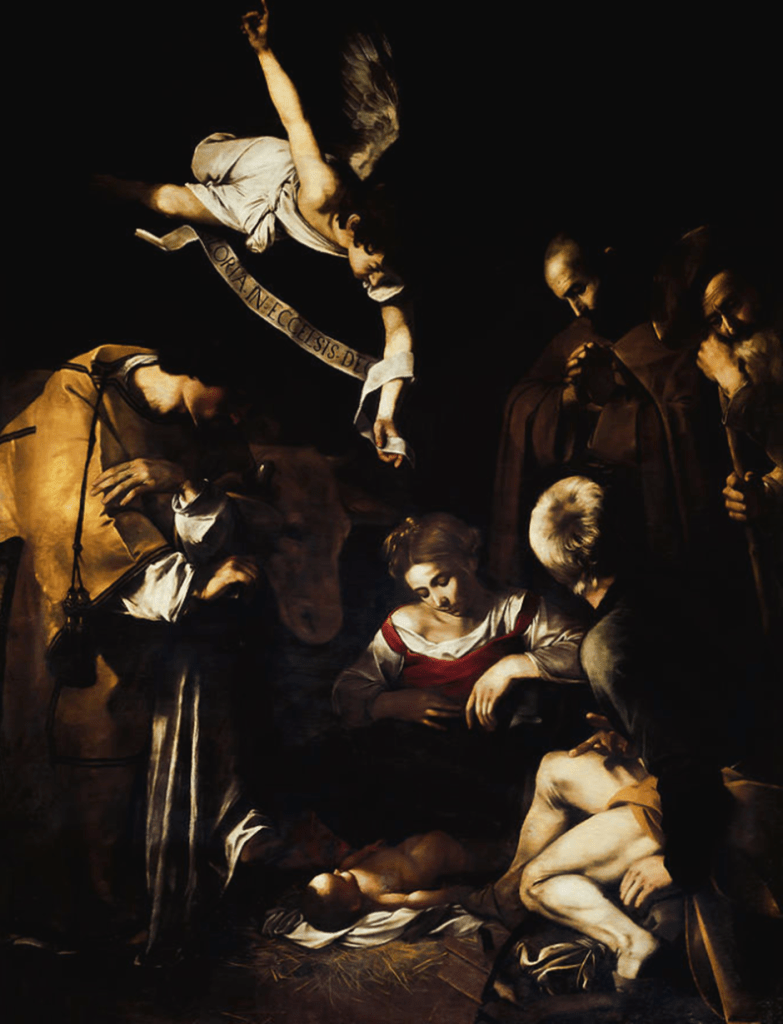
Caravaggio, 1609
Audio Recording:
Text:
One of the peculiarities of recent years when it comes to watching TV programmes is that streaming services are now releasing whole series at a time; to cater for those who wish to binge-watch it all in one go. I’m told that it’s important then to watch as soon as possible, so as to avoid spoilers – accidental comments or articles, often online, that will give away an important part of the story. If you are a person who tries to avoid such spoilers, then I’m afraid you may not like what I have to say about today’s Gospel.
What we have just heard is the prologue to St John’s Gospel. The Fourth Gospel is different to the other Gospels, the synoptic gospels, in a range of ways. It aims not to tell the story of the Kingdom of God, but that of the man, Jesus, and how he fits into, and ultimately is, the history of salvation. In the words of one commentator, “the Prologue… dominates the Gospel like a vast, Gothic archway, giving those who enter a sense of what they are to discover.” This passage is based on an ancient poetical hymn, and was probably added to the Gospel toward the end of its composition, but it serves an important purpose: it provides us, as the reader, with a privileged insight into who this Jesus character is; this man who goes on later in the book to perform miraculous signs of divinity, who claims wondrous titles of Godhood, and who teaches so radically and so remarkably that he literally changed the world. The prologue makes great, even fantastical statements; Truths that we, as readers, will then see the evidence for as we progress through the rest of the Gospel.
But for today let us focus on some of the important features of this passage in this Christmas season. Our first reading is the high point of the Book of Sirach, or as it is often known, Ecclesiasticus. It describes the Wisdom of God, not as something to be gained, as we sometimes find in the Old Testament; but personified – one who was with God from the beginning and who was instructed to “make [her] dwelling in Jacob,” that is, in the Jewish people. This passage was written by an author sometimes known as Ben Sira less than 200 years before the birth of Christ and the personification is typical of the Jewish scholarly understanding of the Wisdom of God that prevailed at that time, and at the time of the writing of the Fourth Gospel. Similarly, ‘the Word of the Lord’ is a common expression in the Old Testament; sometimes referring to words which are efficacious in themselves, whilst at others being the thing, or indeed the one, which is sent.
The early Church realised that the intimate connection between the Divine Word, or Wisdom, and the transcendent, otherworldly nature of the Father, was found in the life, actions and teachings of Jesus Christ. This is why the Prologue begins with the statements of the eternal nature of the Word: “In the beginning was the Word, and the Word was with God, and the Word was God.” These are the origins of the arguments of the Fathers of the Council of Nicea, which has just celebrated its 1700th anniversary. We profess these beliefs every Sunday: the person of Jesus Christ is “God from God, Light from Light, true God from true God, begotten, not made.” All of this speaks of our Lord as the eternal Word and Wisdom of God.
The intermingling of these themes prepares the way for the climactic statement: “the Word became flesh and dwelt among us”. The Gospel writer’s central insight is summed up here – the identification of Jesus Christ with the Old Testament figures of the Word, and therefore of Wisdom: the entire divine plan; from the betrayal of our first parents; to the histories of Abraham, Jacob, Moses; of the Israelites and the Jewish nation that they became; all of it has actually taken flesh in him.
While Word and Wisdom have been sent before, this coming in flesh was something new, something unheard of. While various polytheistic religions of the time had the gods appearing as human – consider the myths of the ancient Greek pantheon; the Greek word used in the Gospel, σαρξ [sarx], leaves no doubt. It is not the word for form, or appearance; it refers only to the physical living body. The Word and Wisdom of God has taken true human flesh. The Catechism recognises this as being the mark of a believer; In its words: “belief in the true Incarnation of the Son of God is the distinctive sign of Christian faith.”
To grasp the second part of that key sentence, “and lived among us,” it is necessary again to consider the Greek. The word translated as lived, εσκηνωσεν [eskenosen], comes from the Greek word for tent, σκηνη [skene], and literally means ‘pitched his tent’, indeed that exact phrase is used in the former translation of our First Reading. This word again echoes the Old Testament – the Tent or Tabernacle of Moses and the earlier Tent of Meeting; the tents in which the Israelites lived during their time in the wilderness, which Jews celebrate at Sukkot; and the veil covering the Holy of Holies in the more permanent Temples of Jerusalem. And to continue the theme, it is the Tabernacle of Moses and the Temple of Solomon which “the glory of the Lord filled,” in the sight of the people; just as “he lived among us, and we saw his glory.” Glory in this sense often means a “manifestation of God’s awesome presence” – consider the cloud and fire on Mount Sinai; there is nothing less wondrous about the miracle of the Incarnation and the child of Bethlehem.
We see in that short statement, ‘The Word became flesh and dwelt among us,’ the culmination and fulfilment of God’s Revelation. In the words of Pope Benedict; “the reality that comes to be in Christian revelation is nothing and no one other than Christ himself. He is revelation.” Yes we must read on to see the story of the Word and Wisdom, who has now taken flesh, but the Prologue leaves us in no doubt who it is that we are reading about.
St Ephrem wrote that God “has hidden many treasures in his word so that each of us is enriched as we meditate upon it.” We have heard this reading three times in the past fortnight, indeed for centuries it was read at the end of every single Mass. Despite that, we must not fall into a complacency; what St Ephrem said is still valid: each time we come to it, if we are open, we will draw something new from it.
In reflecting on the prologue ahead of today’s Mass that word I mentioned earlier stood out: The Greek word for tent or tabernacle, σκηνη [skene], gives us the modern English word scene; derived from the small tents used by ancient actors to change costume between what we would now call their ‘scenes’ on stage. We are, of course, still in Christmastide; as we reflect on the incarnation of the divine Word as a child in a manger, shown in beautiful crib-scenes in churches and homes, perhaps we should also consider for a moment our scene, our place, in the world. Do we make a σκηνη, a scene, a tent, a dwelling, which is welcoming to the Lord? Do we invite the Divine Word, the Wisdom of God, to pitch his tent with us and to work in us? Do we allow ourselves to see his glory in and through our lives? That is St Paul’s prayer in our Second Reading, and mine for us today: “that the God of our Lord Jesus Christ, the Father of glory, may give [us] the Spirit of wisdom and of revelation in the knowledge of him.”


 Lk 22:27