Homily for the Third Sunday of Lent, Year A: The Woman at the Well

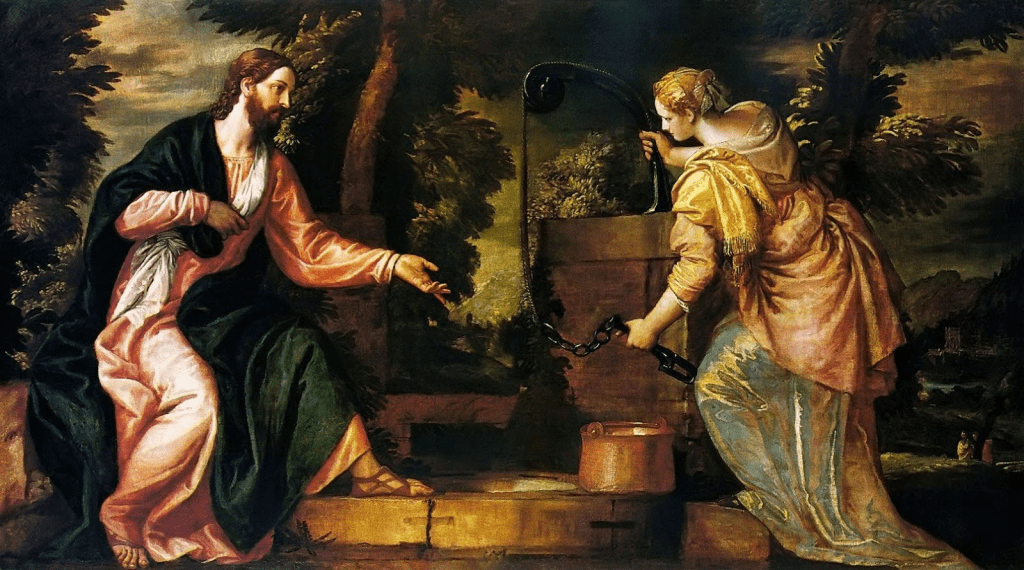
Samaritan Woman by Paolo Veronese, Kunsthistorisches Museum, Vienna, Austria 

One of the criticisms often levelled at the Catholic Church is that we do not read enough of the Bible. The length of today’s Gospel might suggest otherwise, and this was the shortened account!

[For the reader: A reference to the passage used is given at the end of this text.]

The criticism is not entirely unfair however, and while we will never embrace the sola Scriptura, Scripture alone approach of Protestantism, it is a fair question to ask – when and how do we read and reflect on the Word of God?

One approach is Lectio Divina, a process in which a piece of Scripture is read three times, with a period of reflection between each. It is all very contemplative, allowing a word or phrase to jump out at us; that is the word or phrase which we are then called to consider the importance of, for ourselves and in our lives.

Each person brings their own personality to this sort of reflection, and I find that my curious nature is often drawn to the little details: Why did the writer choose to include that – what is the importance of an often apparently trivial detail. When I was reflecting on today’s Gospel, my attention was drawn to a couple of things:

John’s Gospel wasn’t written by him personally, but by a community of his followers. Those followers would have memorised his stories and teachings word for word, after the Rabbinic traditions of the time; but why did John insist that they remembered that this meeting happened at the sixth hour, or include the snippet that “Jews, in fact, do not associate with Samaritans?”

It is no secret that the Samaritans had a long history of conflict with the Jews. They were the remnant of the Northern Kingdom of Israel, with the Jews being the remains of the Southern Kingdom. They had freely intermarried with non-Israelites, and as we hear alluded to in the Gospel, they worshipped God at this mountain, called Gerizim, rather than at Mount Zion – the Temple Mount of Jerusalem. Worse still, the Samaritans had opposed the rebuilding of the Temple in Jerusalem after the Babylonian exile, and the Jews had destroyed the Samaritans’ Temple in turn. It’s safe to say that while the Jews looked down on the Gentiles – the non-Jews, they openly hated the Samaritans.

And what of this sentence “it was about the sixth hour?” The daytime was divided into twelve hours, so the sixth hour refers to the middle of the day, the hottest part of the day; and here was this woman alone at the well. Water would have been collected by the women in the early morning, when the day was cooler and the walk back to the city less arduous. So what was she doing there in all that heat?
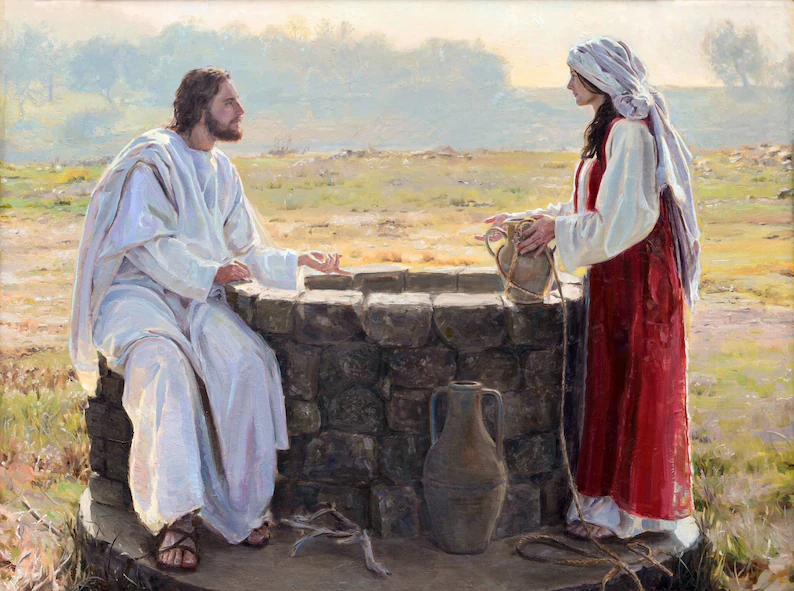
Jesus Christ and the Samaritan Woman at the Well by an unknown artist, Church History Museum, Salt Lake City, USA

Another thing that often catches my eye with the readings at Mass is when I look at the reference at the top of the reading and there are verses missing. In this shortened version, what was said in verses 16-18, and 27-38? The first of those gaps is significant here – Jesus tells this woman something about herself that he should have had no way of knowing – that she had had five husbands, and was now with another man who was not her husband. This is why she calls him a prophet, and later says “he told me all that I have ever done.” It is also very likely the reason that she was disliked by the other women of the city, so much so that she had to come to the well alone at the sixth hour – in the heat of the midday sun.

This all adds up to a woman who was as despised as it is possible to be – excluded by her own people, and they themselves a people who had been shunned for centuries by Jews; Jews like Jesus.

And yet the Lord offers her, even her, living water and eternal life. There is hope for all of us, I think.

But she doesn’t just take from the Lord; she passes on what she has received. Think of those you consider to be credible sources of information – are any of them outcasts like this woman? I suspect probably not. Yet the zeal with which she spoke of the Lord when she returned home inspired those in the city to welcome him and to believe.

That same living water, that same eternal life, is offered freely to every human soul, to every one of us. All we have to do this Lent is turn to him, worship him in spirit and in truth, and he will grant us everything that he promised to the woman at the well; and what is more, we will be filled with the same intensity that caused her, an outcast of outcasts, to speak so fervently, and with such conviction, of the Good News of God.

Gospel Passage for the 3rd Sunday of Lent, Year A, Shorter Form: John 4:5-16, 19-26, 39-42

Lent and ‘Christian Warfare’

Evil exists. The Evil One exists. And Lent is a time to renew our fight against them.

There are many in the world today who doubt what I have just typed. There are many in the Church today who doubt what I have just typed; and it is rare to hear such things in a homily. Such ideas are apparently even more unpalatable to the modern world than the radical teachings of Christianity.

Ironically, even the institutional Church itself would seem to be shrouding such ideas in more favourable language. At an instruction class last week in our parish the translation of prayers came up; consider these two translations of the Collect for Ash Wednesday:

From the Latin typical edition of both the Breviary and the Missal (published in 1970):
Concéde nobis, Dómine,
præsídia milítiæ christiánæ sanctis inchoáre ieiúniis…

From the Breviary, to be used in the Divine Office (translated in 1974):
Support us, Lord, as with this Lenten fast
we begin our Christian warfare…

From the Missal, to be used at Mass (translated in 2010):
Grant, O Lord, that we may begin with holy fasting
this campaign of Christian service…

One does not have to be a Latin scholar to recognise that præsídia milítiæ christiánæ is not best translated as a campaign of Christian service. A strict literal translation would be the garrisons of the Christian army. This is more closely reflected in the older (1974) translation, but who or what are we going into battle against? That prayer goes on to give us an answer: the spirit of evil/spiritual evils. In this we must see the person of the Devil.

The Catechism writes (CCC 2851) of the line in the Our Father, but deliver us from evil, that “evil is not an abstraction, but refers to a person, Satan, the Evil One, the angel who opposes God.” In combatting his influence in our lives and in our world, we bring ourselves closer to God; because we reject and fight against not just him, but all evil. St Augustine described evil as “an absence of good;” anything which stems from God is good, anything which lacks God’s goodness is the work of the Devil. As the Catechism continues (CCC 2854), “When we ask to be delivered from the Evil One, we pray as well to be freed from all evils, present, past and future, of which he is the author or instigator.”

This has been the view of the Church from its earliest days and only recently has evil seemingly become a term to be avoided. Some early Christian examples include St Peter, who wrote (1 Pet 5:8) to suffering Christians, “your adversary the devil prowls around like a roaring lion, seeking someone to devour. Resist him, firm in your faith;” and St Paul, who blamed the devil for preventing his visit to Thessalonica (1 Thess 2:18) – “we wanted to come to you… but Satan hindered us.”

The effect of evil in our day to day lives as Christians is of course sin – those times when we turn away from God and give in to the temptations of false happiness offered by the Father of Lies. Fortunately the Church offers us the spiritual weapons needed to fight against such temptation, and insists on our use of them in the Holy Season of Lent.

The word insists in the last sentence may seem authoritarian, but the Church does exercise her authority in this. The Church has five precepts, which I will again turn to the Catechism to define (CCC 2041): “The precepts of the Church are set in the context of a moral life bound to and nourished by liturgical life. The obligatory character of these positive laws decreed by the pastoral authorities is meant to guarantee to the faithful the very necessary minimum in the spirit of prayer and moral effort.” (Emphases are my own)

The fourth precept of the Church binds us to observe the times of fasting and abstinence laid down by the Church (CCC 2043). While there are days of defined fasting and abstinence, the spirit of self-denial extends to all of the days of penance, which includes “every Friday of the whole year and the season of Lent.” (CIC 1249-50)

Along with Prayer and Almsgiving, Fasting is one of the weapons with which we are called to battle sin during Lent. It is the inward facing weapon with which we battle temptations in the depths of our heart. We deny ourselves in imitation of the Lord in the desert, as we will hear about in the Gospel of the First Sunday of Lent (Mt 4:1-11); after his time of fasting the Lord was able to reject the temptations of the Devil. Some would say that the Lord’s rejection was a foregone conclusion because of his divinity, but that was not the case; his humanity caused him to feel temptation just as we do. What is more, there were no witnesses save the Lord and the Devil, and yet the Lord felt his time of fasting and temptation was important enough to later recount it to the Apostles, who passed it into the Gospels.

Some would point to the Gospel of Ash Wednesday (Mt 6:1-6,16-18) and say that fasting is not something to be talked about. I would certainly agree that it is not to be boasted about, especially not in the seeking of recognition or adulation; but that is not to say that it should not happen at all. Indeed, the words that the Lord uses, When you fast… suggests an assumption that fasting definitely will take place; and if fasting must take place, then at the least there must be a discussion of what it involves, or no one new to the faith (as a child or an adult) would ever learn about it.

Fasting is a form of self-discipline. Whatever we fast from, it must be something we will miss. This principle is understandable even to the very young. Children will often joke that they will give up broccoli or some similarly disliked food, usually with the full knowledge of the humour they are sharing by apparently missing the point of a fast. What we are doing when we fast is denying ourselves something morally neutral, so that we can be confident in our ability to deny ourselves things which are attractive. Then when things morally evil come along, we can be confident in our ability to deny them too; and with them, the author of all that is evil – that same Satan that tempted our Lord. In this way we prepare ourselves worldly to celebrate the liturgies of the Holy Triduum, and spiritually for the eternal reward won for us in the Paschal mysteries.

By way of a summary, I will give the final words here to the Prayer over the Offerings for Ash Wednesday:

We entreat you, O Lord,
that, through works of penance and charity,
we may turn away from harmful pleasures
and, cleansed from our sins, may become worthy
to celebrate devoutly the Passion of your Son.
Who lives and reigns for ever and ever.