
Today we keep the octave day of Christmas, which in the Church’s calendar is given to Mary as the Mother of God. This title is very simple to say, but is arguably the most significant out of all of those given to Mary; so much so that it caused much discussion in the early Church.
Many of you will know that I am something of a pedant, and I will happily have an hour’s discussion over the use of a single word or comma. I suspect therefore that I would have greatly enjoyed the Council of Ephesus, at which two great characters of Church history battled it out over a single word. On one side was a character called Nestorius, who argued that Mary’s motherhood was simply linked to the humanity of Christ; so, without disrespect, she should at best be considered the Mother of Christ. On the other hand was St Cyril of Alexandria who pointed out that as Christ’s humanity and divinity cannot be separated, Mary was not only Mother of the human Jesus, but the Mother of God, in all his divinity.
As you can tell from the name of today’s Feast, and his sainthood, St Cyril won the argument, and Nestorianism was declared a heresy in the Church. This is why today the universal Church recognises the mother of that tiny child in the manger as the Mother of God; the same God who spoke to the patriarchs and prophets; the same God we hear speaking to Moses in our first reading.
St Paul tells us today that it is through the incarnation of Christ that we have all become adopted as sons and daughters of God. That of course means that we have become Mary’s children too. This does not in any way equate Mary with Almighty God, as some protestants would suggest. We revere Mary for her role as the first believer in, and the first adorer of, the Christ-child. In this she is the perfect image of all believers, but just like all believers her own salvation comes only through the grace of God.
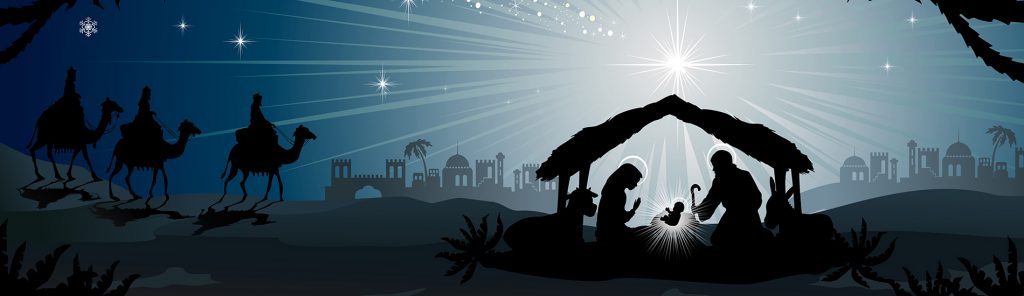
But it is not Nestorian to remember also today the normality of Mary’s role in the childhood of the Lord. Jesus was God, but he was also a defenceless child. He had his mother, Mary, and his earthly father, Joseph. They loved him, and cared for him, and raised him; in a very normal and human way.
In the run-up to Christmas, I was lucky enough to go into one of my parish’s schools and decorate a Bambinello with my son. That baby is now in our nativity scene at home, where it will stay until Candlemas. After that it may be put away with the Christmas things, or it might go into his keep-sake box.
I suspect most families will have, somewhere in their house, a keep-sake box for their children. A gradually expanding collection of school reports, certificates and artworks. As important as they are, these physical objects hold value to us for the occasions that they bring to mind. Opening that box is a way of remembering those memorable times, some of which we might otherwise have forgotten.
The most important occasions, of course, it would be impossible to forget even if we tried. For those of us who are married, our wedding day is probably one. For those who are parents, the days of our children’s births will be others. Of course, such events may not always be positive; the loss of a loved one or the discovery of an illness can be just as memorable, albeit in a very different way.
Memories though, however vivid, are only ever in our minds; to truly reflect on them, on emotional and spiritual levels, we must use our hearts. This is what St Luke means when he says that Mary ‘treasured these things and pondered them in her heart.’ She knew that what was happening in that stable of Bethlehem was important. It was life-changing for her, as any mother knows, but it was more than that. This child was going to change the world. How, she did not understand; but her ‘fiat’ went far beyond simply carrying and birthing this child that an angel had called the Son of God; she was now the mother who would raise him. Theologians’ arguments aside, she was – and she knew she was – even in that humble stable, the Mother of God.
Some people prefer a sanitised view of the Christ-child and Mary’s care for him. The child described in the carols: ‘Christian children all must be, mild, obedient, good as he.’ The reality however must have been different: Christ embraced our humanity in everything but sin; so how did he tell Mary that he was hungry, or that his nappy needed changing? He would have cried, like any baby. How did he grow and learn all the things that everyone has to learn? He learned by asking his mother.
In contemplating this normality of the Lord’s upbringing I was reminded of a Catholic cartoon which goes around every so often on the internet with the title ‘Jesus prays the first rosary,’ or similar. The image shows a young Jesus looking up at Mary and tugging at her skirts while repeating over and over ‘mum, mum, mum, mum, mum…’ A very normal thing for a lot of mothers and their children.
[For those reading online a copy of this image is below]

We are the spiritual children of Mary, so we should have no fear of turning to her in our need just as the child Jesus did. And yes that means sometimes being that child and repeating ever more fervently ‘mum, mum mum!’
I think it is right today to finish by asking our Lady, our heavenly mum, to lead the saints and angels in intercession for the repose of the soul of dear Pope Benedict.
Mother of God, all Saints of God, come to his aid; Hasten to meet him, angels of the Lord. Receive his soul and present him to God, the most high.
 Lk 22:27