Homily for the 19th Sunday in Ordinary Time, Year A: Creation itself obeys the will of God

Audio Recording:

Text:

The recent success of the film Oppenheimer has drawn the public consciousness to some of the great, and at times terrible, discoveries of the first half of the twentieth century. Those discoveries of course, stemmed from attempts to understand a very base question of our existence: ‘what is stuff made of?’

The ancient understanding of the elements was of course very different to that of Oppenheimer and his contempories. In the time of Christ, the answer that everything is made of Earth, Air, Fire and Water (and later Ether) was broadly accepted among those who cared to ask such questions.

Water and Fire were understood as the extremes of the elements. Where Earth and Air were relatively passive, Water and Fire had the capacity to destroy and to take life. Water in particular had that reputation to the Jews – both for the disciples themselves and for the Jewish audience that St Matthew wrote his Gospel for. One might consider the Flood and Noah’s Ark in Genesis, the storm that turned back the prophet Jonah, or the destruction of Pharoah’s army in the Red Sea – these stories were well known. Yet all those familiar stories have something in common besides an awful lot of destructive water. They all make clear that the seas; the elements themselves; creation itself; obeys the will of God.

These stories were then reflected in the psalms that Jesus and the disciples would have prayed daily. Psalm 89 says: “Who is like you, LORD God Almighty? … You rule over the surging sea; when its waves mount up, you still them.” And in another psalm: “The LORD stilled the storm to a whisper; the waves of the sea were hushed.” The word translated as LORD in both of those psalms refers the Holy Name of God; sometimes translated as I AM, in Greek ego eimi. Jesus’ use of that phrase is more often associated with St John’s Gospel, but it is exactly the phrase that Matthew records in today’s passage, translated for us as ‘It is I’. To the Jewish disciples, Jesus’ words identify him both as the man they know, but also as God.

Peter steps out of the boat, and with his eyes fixed on his friend, his friend who has just identified himself as God, walks across the water; but as soon as his mind is drawn from God by the wind and the storm, he begins to sink. The Lord reaches out to him and brings him back to the boat, at which point the wind and the heavy seas calm instantly. Creation itself obeys the will of God.

In all of this we can draw a multitude of analogies: Perhaps we recognise in the disciples’ boat the Barque of Peter – that ancient allegory of Mother Church herself. Perhaps we see ourselves as Peter, needing to keep our eyes on the Lord and avoid the distractions of the material world; or perhaps we see ourselves as one of the others in the boat, wishing we had Peter’s confidence in calling out and his faith in taking those first steps. Perhaps we feel ourselves sinking right now, and long for the Lord to reach out and lift us up; or perhaps we happily feel that the Lord has recently calmed the waters of our lives.

Regardless of where we might consider ourselves in that story, this final thought, I hope will be relevant. It stems from my reflections in the parish Lectio group last Monday morning; and as we reflected on this scripture the phrase that jumped out at me was: “In the fourth watch of the night.” That would be between three and six in the morning – the Lord had left them in their struggle against the wind from the evening-time all the way through to the hours before dawn. That was more than enough time to reach their destination on the far shore, had the weather been favourable, and yet they had done nothing but struggle on without him.  

Sometimes we struggle, just like the disciples in the boat. Sometimes the Barque of the Church herself appears to be merely struggling along in a hostile world. Sometimes it can feel as though the stresses and worries of the world, even the very fabric of the world – the elements themselves, are conspiring against us. What today’s Gospel shows us is that the Lord will always be there for us in those trials. Not as we expect necessarily – the disciples’ did not expect to see him walking on the sea, perhaps not even as we would like him to be – the disciples could have done without that sleepless night fearing for their lives, I’m sure; but he will be there when we truly need him. All we need to do is endure the trials, the crosses, which in his wisdom he sends to us and be willing at the appointed time to cry out in the words of Peter: “Lord! Save me!” Because at those words he will surely reach out and bring us to safety, for nothing is impossible for him – even Creation itself obeys the will of God.
The deacon’s bits…

Okay the title might be a little provocative, but once the Carry On fans at the back have finished sniggering, we can begin…

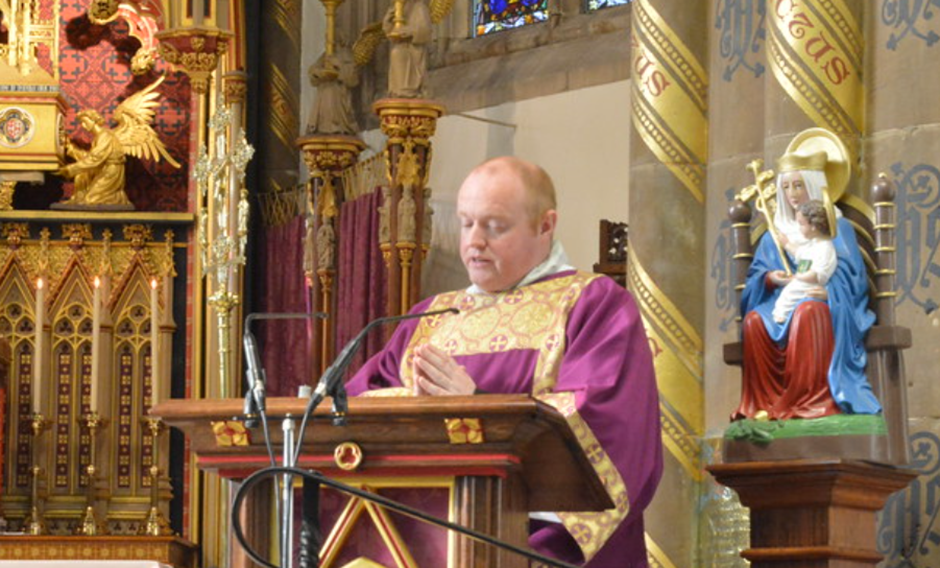
Since my ordination last summer I have fielded a number of questions from parishioners about the deacon’s role at Mass. In this post I hope to provide an overview of where deacons fit into the liturgical life of the Church, particularly at Holy Mass, and use ‘the deacon’s bits’ – that is, the parts of the Mass in which a deacon says or does something, to illustrate some wider truths about the diaconate as part of the Sacrament of Holy Orders.

The first thing to say is that in the experience of most Catholics, the deacon appears to turn up and take some of the priests’ roles. That’s not strictly true – for the most part the roles I’m going to be discussing here are those proper to a deacon, which means that if a deacon is assisting at the Mass, then he should be the one to say or do that thing. For instance, it comes as a surprise to some people when I mention that you will never see the Pope read the Gospel in St Peter’s, because arrangements are always made for a deacon to be present at such large Masses. Of course, St Peter’s is not a typical parish church, and the Pope is not a typical parish priest. In the absence of a deacon at Mass, a priest steps into those roles, as he is also a deacon, having usually been ordained such about a year before his ordination to the priesthood. It was quite unexpected, but very nice, to be greeted as a ‘brother deacon’ by a number of priests following my ordination.

The deacon’s roles at Holy Mass largely fall under three identities: as a herald of the Gospel, as an image of Christ the Servant, and as the link between the Altar and the Faithful.

A Herald of the Gospel:

We have already mentioned the proclamation of the Gospel as a proper function of the deacon. Immediately after his ordination, a deacon kneels before his bishop and is handed a book of the Gospels as the bishop says to him; “receive the Gospel of Christ, whose herald you now are: Believe what you read, teach what you believe, and practice what you teach.” The diaconate order has been associated with proclaiming and teaching the faith since ancient times, and although it lost something of its identity by becoming a precursor to the priesthood (until its restoration as a permanent order in the 1960s) it still existed within the liturgy, with the role of the deacon at a High Mass usually being filled by a second priest. This identity as a herald of the Gospel is also the basis of the deacon’s permissions to preach, including homilies at Mass; the graces of ordination allow us to share in our Bishop’s teaching authority, and he grants us the faculties to “exercise the ministry of preaching the Word of God, as a service to the people, and in communion with the Archbishop and the priests.”*

One of the differences that does apply to deacons is that before we proclaim the Gospel, we ask the blessing of the celebrant, by bowing to him and asking quietly, “your blessing, Father.” The deacon then receives a short blessing from the celebrant, which bears a number of similarities to the prayer which a priest would himself say before the Gospel. Following the Gospel the deacon reverences the book in the same way as a priest by kissing the opening words of the passage whilst praying quietly “through the words of the Gospel may our sins be wiped away.”

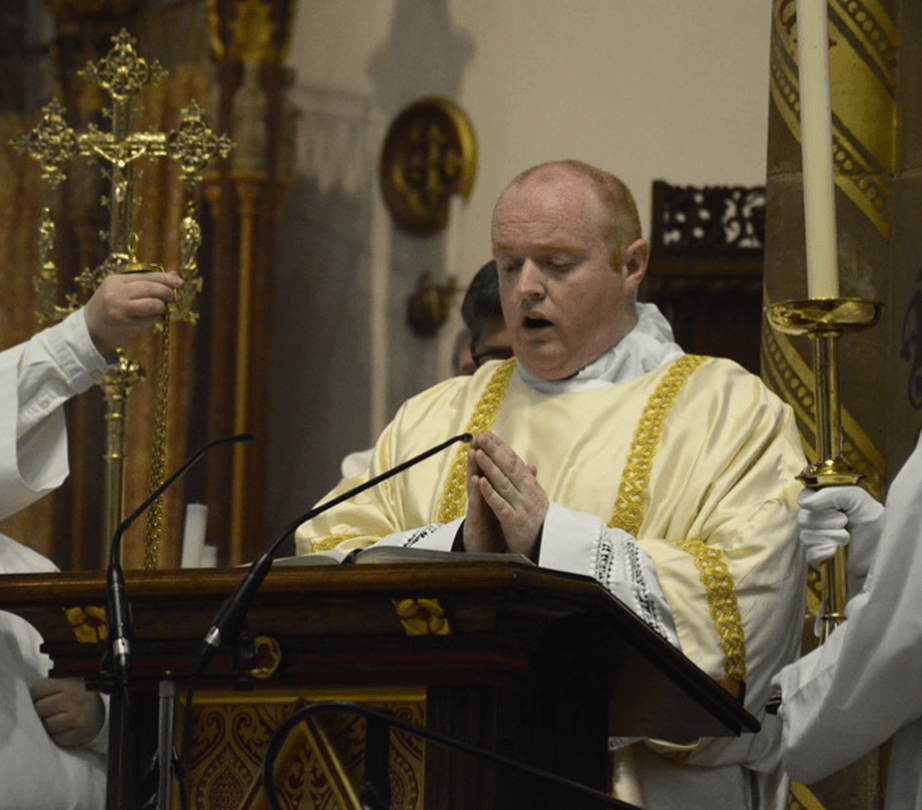
Chanting the Gospel.
Priestly Ordination Mass of Fr Toby Duckworth and Fr Steven Fleming, 2023. St Chad’s Cathedral, Birmingham.

An Image of Christ the Servant:

The word deacon comes from a Greek word which translates as servant. It should be no surprise therefore that many of the deacon’s liturgical functions appear to be acts of service at the altar. The deacon prepares the altar and adds wine and water to the chalice with the quiet words “through the mystery of this water and wine, may we come to share in the divinity of Christ, who humbled himself to share in our humanity.” He then hands the paten and the prepared chalice to the priest in turn. Depending on the celebrant’s wishes the deacon may also cover and uncover the chalice as needed, and turn the pages of the Missal for the priest. The deacon also elevates the chalice for the conclusion of the Eucharistic Prayer, though he does not sing or say the words – they are still a part of the Sacrifice of the Mass, which is the function of the priest(s) who is (are) celebrating the Mass; instead he joins with the rest of the people in acclaiming the Lord in the final Amen. After Holy Communion the deacon can, if the priest wishes, purify the sacred vessels and return everything to their proper places.

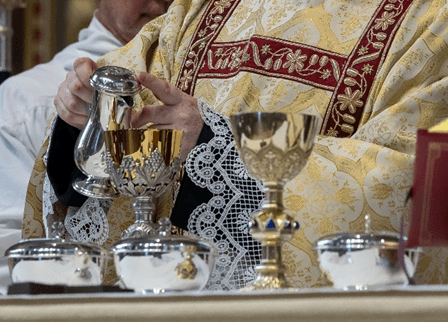
Preparing the Chalice.
My Ordination Mass, 2022. St Chad’s Cathedral, Birmingham.

On the Distribution of Holy Communion:

A mention should be made here of the distribution of Holy Communion. A deacon is an ordinary minister of Holy Communion. This means that the Church allows him to distribute Holy Communion by virtue of his Order, without a special commissioning, such as that required to allow lay people to serve as extra-ordinary ministers of Holy Communion. However, a deacon receives Holy Communion just like a lay person, from the hand of another minister – usually the celebrant of the Mass. The celebrant of the Mass will usually distribute Holy Communion, but there is a question, it seems, of who should be the ‘second’ minister of Holy Communion if both a deacon and a concelebrant priest is present. I have not been able to find a clear and satisfactory answer to this question, but my opinion would be that if there are concelebrating priests present, the intimate connection between their Order and the Blessed Sacrament would suggest that they should distribute Holy Communion before the deacon(s) of the Mass.

Since my ordination a couple of people have asked me why I receive Holy Communion on the tongue, when I am about to distribute it with my hands. I hope that this note has addressed that: priests communicate themselves; my own reception of the Lord is from the hands of the priest. That did not change with my ordination as a deacon, despite my being in the privileged position of having the faculty to then aid the priest if needed in the distribution of Holy Communion to the faithful.

As the Link between the Altar and the Faithful:

The deacon has a number of little phrases to say aloud during the Liturgy. The most noticeable is the dismissal at the end of Mass – “go forth the mass is ended,” or one of the other options available in the Missal. There are others, such as the instruction to “bow down for the blessing” before a solemn blessing, or the repeated “let us kneel” and “let us stand” during the solemn intercessions on Good Friday. These instructions can seem rather curt and even rude, but the English translations are actually rather toned down; the literal translations are very clearly instructions. For example, the single word instruction levate, translated as “let us stand” would more strictly be simply “stand up.”

Translations aside, it is a fair question to ask why it falls to the deacon to give these announcements. The answer is simply that deacons are a link from the altar to the people, and vice versa. The celebrant addresses the people at different points in the Mass, such as with the words “the Lord be with you;” “pray brethren that my sacrifice and yours…;” or “behold the Lamb of God…;” but when instructions are to be given, it falls to the deacon to give them. This is also the reason why, after the priest has incensed the altar, it is the deacon’s role to incense in turn the priest, other clergy (usually concelebrants), and then the congregation in the main body of the church.

Another aspect which emphasises the deacon as the link between the altar and the people is the reading of the Universal Prayer, or ‘Bidding Prayers.’ While this is a role proper to the deacon, in many parishes a lay person reads these intercessions and a pastoral reason is given for this, usually something along the lines of ‘that’s what we always did before we had a deacon.’ I am not, and have never met a deacon who is, particularly precious about reading the Bidding Prayers at Mass, but the principle of praying at the altar for the needs of the world definitely fits into this meaning of the diaconate.

Reading the Intentions of the Universal Prayer.
Rite of Election, First Sunday of Lent, 2023. St Chad’s Cathedral, Birmingham.

Conclusion:

This post has not taken a toothcomb through the Liturgy to examine every thing a deacons says or does, but it has covered most of them. What I hope it has achieved is to draw out some of the unique theology of the diaconate as one of the Holy Orders, and demonstrate how these aspects are expressed at Holy Mass.

With every blessing,

Martin

* Note: That quote is taken directly from my letter of appointment, and so refers to ‘the Archbishop’ as I live and minister in an Archdiocese. Everything said in relation to a bishop applies to any local Ordinary, whether a bishop or archbishop.

Lent and ‘Christian Warfare’

Evil exists. The Evil One exists. And Lent is a time to renew our fight against them.

There are many in the world today who doubt what I have just typed. There are many in the Church today who doubt what I have just typed; and it is rare to hear such things in a homily. Such ideas are apparently even more unpalatable to the modern world than the radical teachings of Christianity.

Ironically, even the institutional Church itself would seem to be shrouding such ideas in more favourable language. At an instruction class last week in our parish the translation of prayers came up; consider these two translations of the Collect for Ash Wednesday:

From the Latin typical edition of both the Breviary and the Missal (published in 1970):
Concéde nobis, Dómine,
præsídia milítiæ christiánæ sanctis inchoáre ieiúniis…

From the Breviary, to be used in the Divine Office (translated in 1974):
Support us, Lord, as with this Lenten fast
we begin our Christian warfare…

From the Missal, to be used at Mass (translated in 2010):
Grant, O Lord, that we may begin with holy fasting
this campaign of Christian service…

One does not have to be a Latin scholar to recognise that præsídia milítiæ christiánæ is not best translated as a campaign of Christian service. A strict literal translation would be the garrisons of the Christian army. This is more closely reflected in the older (1974) translation, but who or what are we going into battle against? That prayer goes on to give us an answer: the spirit of evil/spiritual evils. In this we must see the person of the Devil.

The Catechism writes (CCC 2851) of the line in the Our Father, but deliver us from evil, that “evil is not an abstraction, but refers to a person, Satan, the Evil One, the angel who opposes God.” In combatting his influence in our lives and in our world, we bring ourselves closer to God; because we reject and fight against not just him, but all evil. St Augustine described evil as “an absence of good;” anything which stems from God is good, anything which lacks God’s goodness is the work of the Devil. As the Catechism continues (CCC 2854), “When we ask to be delivered from the Evil One, we pray as well to be freed from all evils, present, past and future, of which he is the author or instigator.”

This has been the view of the Church from its earliest days and only recently has evil seemingly become a term to be avoided. Some early Christian examples include St Peter, who wrote (1 Pet 5:8) to suffering Christians, “your adversary the devil prowls around like a roaring lion, seeking someone to devour. Resist him, firm in your faith;” and St Paul, who blamed the devil for preventing his visit to Thessalonica (1 Thess 2:18) – “we wanted to come to you… but Satan hindered us.”

The effect of evil in our day to day lives as Christians is of course sin – those times when we turn away from God and give in to the temptations of false happiness offered by the Father of Lies. Fortunately the Church offers us the spiritual weapons needed to fight against such temptation, and insists on our use of them in the Holy Season of Lent.

The word insists in the last sentence may seem authoritarian, but the Church does exercise her authority in this. The Church has five precepts, which I will again turn to the Catechism to define (CCC 2041): “The precepts of the Church are set in the context of a moral life bound to and nourished by liturgical life. The obligatory character of these positive laws decreed by the pastoral authorities is meant to guarantee to the faithful the very necessary minimum in the spirit of prayer and moral effort.” (Emphases are my own)

The fourth precept of the Church binds us to observe the times of fasting and abstinence laid down by the Church (CCC 2043). While there are days of defined fasting and abstinence, the spirit of self-denial extends to all of the days of penance, which includes “every Friday of the whole year and the season of Lent.” (CIC 1249-50)

Along with Prayer and Almsgiving, Fasting is one of the weapons with which we are called to battle sin during Lent. It is the inward facing weapon with which we battle temptations in the depths of our heart. We deny ourselves in imitation of the Lord in the desert, as we will hear about in the Gospel of the First Sunday of Lent (Mt 4:1-11); after his time of fasting the Lord was able to reject the temptations of the Devil. Some would say that the Lord’s rejection was a foregone conclusion because of his divinity, but that was not the case; his humanity caused him to feel temptation just as we do. What is more, there were no witnesses save the Lord and the Devil, and yet the Lord felt his time of fasting and temptation was important enough to later recount it to the Apostles, who passed it into the Gospels.

Some would point to the Gospel of Ash Wednesday (Mt 6:1-6,16-18) and say that fasting is not something to be talked about. I would certainly agree that it is not to be boasted about, especially not in the seeking of recognition or adulation; but that is not to say that it should not happen at all. Indeed, the words that the Lord uses, When you fast… suggests an assumption that fasting definitely will take place; and if fasting must take place, then at the least there must be a discussion of what it involves, or no one new to the faith (as a child or an adult) would ever learn about it.

Fasting is a form of self-discipline. Whatever we fast from, it must be something we will miss. This principle is understandable even to the very young. Children will often joke that they will give up broccoli or some similarly disliked food, usually with the full knowledge of the humour they are sharing by apparently missing the point of a fast. What we are doing when we fast is denying ourselves something morally neutral, so that we can be confident in our ability to deny ourselves things which are attractive. Then when things morally evil come along, we can be confident in our ability to deny them too; and with them, the author of all that is evil – that same Satan that tempted our Lord. In this way we prepare ourselves worldly to celebrate the liturgies of the Holy Triduum, and spiritually for the eternal reward won for us in the Paschal mysteries.

By way of a summary, I will give the final words here to the Prayer over the Offerings for Ash Wednesday:

We entreat you, O Lord,
that, through works of penance and charity,
we may turn away from harmful pleasures
and, cleansed from our sins, may become worthy
to celebrate devoutly the Passion of your Son.
Who lives and reigns for ever and ever.

Those who trespass against ‘uzz’ or ‘uss’?

One of my many obscure interests is in the rhythm and stress patterns in texts, especially in poems and liturgical texts such as hymns, psalms and prayers. Over the past few years one particular stress pattern used when praying the Our Father has intrigued me because when it is combined with the accents of the Midlands of England, it suggests that an important aspect of the Our Father is being missed or misunderstood. If you have a different accent, the pronunciation part of my thoughts below may not mean a great deal, but I hope that the ideas of stress patterns will.

All of this may seem a strange starting point for a religious reflection to take, but please bear with me.

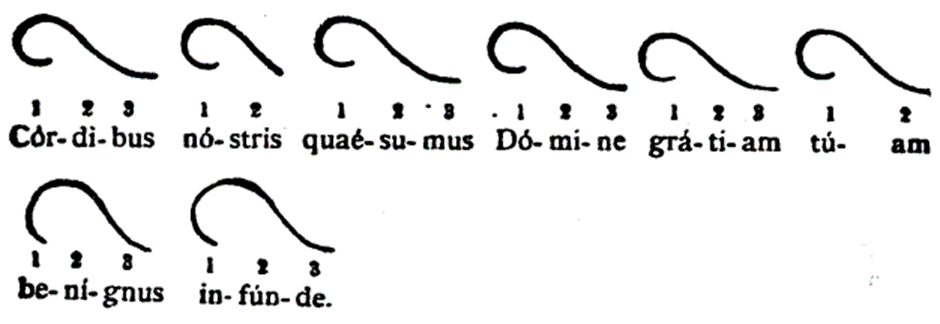
Whether we realise it or not, in spoken English we emphasise certain syllables over others. This is because every text contains stressed and unstressed syllables. When chanting, these syllables become even more important, partly for rhythm and partly because they indicate on which syllables the note will change. This is why the psalms of the Breviary are written out with accents – the accents indicate the syllables to be stressed as one reads or chants. Consider the opening of Psalm 50 (51):

Have mércy on me, Gód, in your kíndness. *
In your compássion blot óut my offénce.
O wásh me more and móre from my gúilt *
and cléanse me fróm my sín.

Below is a recording of this verse being spoken aloud:

And sung to psalm tone 3g, as found in the Liber Usualis:

The Liber also contains (in Latin) a simple, yet wonderful illustration of this ebb and flow between stressed and unstressed syllables:

This brings me neatly to the title of this reflection. The word us can be read in two different ways in some English accents. In the Midlands of England, it is often pronounced uzz, with a long ‘z’ sound, rhyming with buzz. Sometimes however it is pronounced uss with a shorter, harder ‘s’ sound, rhyming with fuss; this is less common and usually happens when the word us is itself a stressed syllable, such as at the end of a phrase or sentence.

This may all seem terribly trivial, but consider now the final sentence of the Our Father, punctuated and line-broken as it appears in the Missal:

“Give us this day our daily bread,
and forgive us our trespasses,
as we forgive those who trespass against us;
and lead us not into temptation,
but deliver us from evil.”

The Our Father is of course a prayer we say regularly, and it can be very tempting to rattle through such prayers without really considering their words. Although one sentence, the semi-colon at the end of the third line is a clear split between two separate requests: we ask for God’s forgiveness in lines two and three, and then ask him to keep us clear of temptation and sin in the future. As line three ends a phrase and a specific request we should make an effort to pronounce us with a clear, short uss sound; but in haste we are often looking straight to the end of the sentence and resort to the longer and more common uzz sound instead.

On a deeper level, when we are hurrying, we are not fully considering the words we are saying; we don’t take the time to appreciate the ‘us’ in those lines. We are asking God’s forgiveness for the things we do to offend him, but only in the same manner as we forgive those who sin against us. That is a big deal for the Christian life – we are called to forgive as we wish the Father to forgive us. I don’t know about you, dear reader, but I have a great deal I would like forgiveness for; and so I must endeavour to be forgiving in every single situation where someone upsets or hurts me.

Of course, we are not trying to strike a divine bargain with God – he will, in his love, forgive us anything anyway, as long as we show true repentance. But Jesus did not leave us these words in example for nothing; he left them as a guide both for prayer, but also for life. We will live a better, a more fulfilled, and, most importantly, a more holy life if we follow the example of forgiving others who trespass against us.

That is the message which we gloss over and do not take the time to consider every time we rush through an Our Father, all because of a lack of emphasis on a word just two letters long.

What the Magi did not say…

It is often pointed out that the character of St Joseph never speaks in the Gospels. His earthly fatherhood is one of silent constancy. Without the words themselves we still see a man of faith, who trusted in the messages given to him by God; and in that faith he was able to love the Lord. There is a great deal of good in his silent example alone, but this Epiphany a connection occurred in my mind between St Joseph and the lesson of the Magi. Credit must go to my school’s chaplain for prompting this connection in something he referred to in his Epiphany homily, 2023.

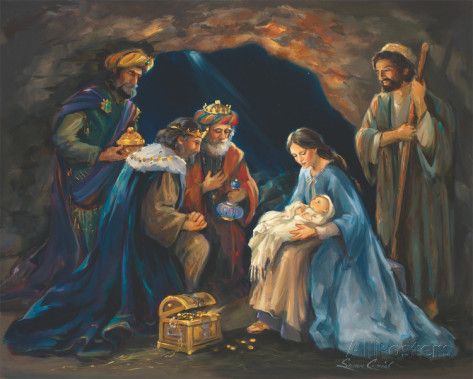
Image: Wise Men Seek Him by Susan Comish

The Magi’s journey would not have been easy for many reasons: the distance; the weather; the dangers of robbery and so on. One of the difficulties not often considered would be language. The Magi were educated men, and when they came searching for the infant King of the Jews they logically went first to Jerusalem. There they conversed with the great and the good; learned scholars who had spent their lives in the study of various disciplines, and of course, King Herod himself. Aramaic was not a widely known language, so it is likely that these conversations took place in a common language such as Hebrew, Greek or Latin, or through court translators. The Magi would have been prepared for this; they would have known how the courts of great men worked, and the etiquette to be followed. They asked their questions and were honest in the answers they gave to Herod’s questions in return. But then they were pointed to a small town south of the city; there would be no scholars or translators there.

And so comes our parallel with the silence of St Joseph. The talkative Magi of Jerusalem do indeed find what they sought. “Going into the house they saw the child with his mother Mary, and falling to their knees they did him homage.” St Matthew puts no words into their mouths now. Perhaps a difficulty of language rendered conversation impossible; perhaps they were struck with a divine awe; perhaps there was an awkward and unrecorded conversation of sorts. Whatever the truth of that visit, St Matthew chooses to recount their visit as an example of silent homage to the Christ-child. They knew that this child was something special. Psalm 111 teaches that “the fear of the Lord is the first stage of Wisdom.” It seems from their visit to Jerusalem that their knowledge of the Jewish scriptures was lacking, but if proof of the Magi as ‘wise men’ were needed, we should have all we need in the way that they fell to their knees in silent wonder.

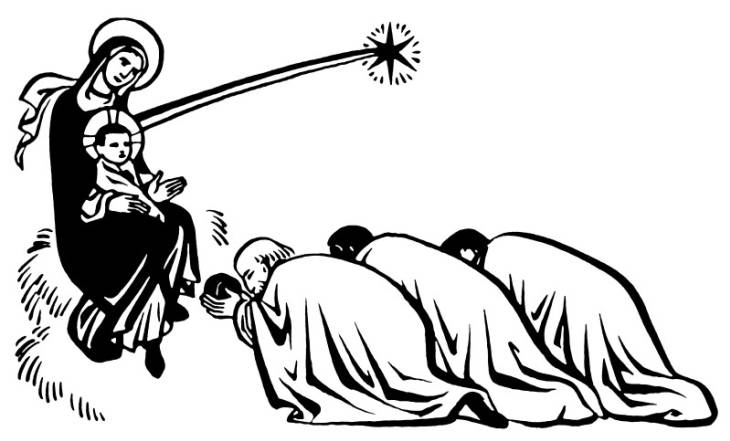
Image: Wise Men Adoring Christ Child by Ade Bethune

From the earliest days of the Church silence has been recognised as a powerful thing. The Lord himself would retreat into the wilderness alone or with his disciples to pray and commune with his Father. John the Baptist, the desert fathers and medieval hermits all recognised that the Lord could be found in the quiet of the wilderness. Contemplative religious orders spend much of their time in silence listening for the Lord’s guidance and praying for the needs of the world without distraction.

Of course for those of us in the secular world, noise is a constant. Sometimes that is external noise: cars, music and conversation around us; but sometimes it is the noise of our own minds, which cannot switch off from the cares and worries of daily life. Fortunately as Catholics we have a beautiful solution to this. Adoration of the Blessed Sacrament, whether at Exposition with the Lord in a monstrance or of the reposed Sacrament in a tabernacle, gives us time to remove ourselves from the noise of the world. Any church provides the respite from the external noise, but releasing our own minds is far more difficult. I do not intend to give a list of exercises for quietening one’s mind in prayer here, but I will suggest that it takes practice, and we should not be disheartened or put off because we find it difficult to let go of our earthly worries the first time, or consistently every time we try.

What we can and really must do, is make the effort. While our internal journey is very different from the travelling of the Magi, it can seem just as difficult. What we can be assured of however, is that it has the same end; to offer our true and complete homage to the one Lord and Saviour. We can be sure that whenever, and however often we come to him, the Lord will be waiting for us: “Jesus Christ is the same yesterday and today and forever.”

Anything but grace?

“For what greater grace could have dawned upon us from God, than that him who had only one Son, made him the son of man, and so in turn made the son of man a son of God. Ask yourself whether this involved any merit, any motivation, any right on your part; and see whether you find anything but grace!”

These are the words of St Augustine of Hippo in the Office of Readings for Christmas Eve. As we draw at last to the end of Advent, St Augustine invites us to consider the why of Christmas.

The Adoration of the Child is depicted in this 17th-century painting by Dutch artist Gerard van Honthorst.

The first sentence of that quote can seem quite bewildering, but it is a rephrasing of the fundamental Christian reality: God sent his only Son into the world as a man, to redeem all of mankind to himself. In the words of St Paul in his letter to the Galatians: “God sent forth his Son, born of a woman… so that we might receive adoption as sons.” The Nativity of the Lord which we are about to celebrate is the beginning of this mystery; the Son coming to earth. We must of course wait until the Easter Triduum to celebrate its terrible and glorious fulfilment in the Passion, Death and Resurrection of the Lord.

This is the root of our faith, but as St Augustine points out, we must ask why? Psalm 8 asks just this question of the Lord: “What is man that you should keep in mind, mortal man that you care for him?” What has mankind done to warrant the coming of our God to earth, on that first Christmas, or this one, or any in between? St Augustine offers us an answer in a roundabout way:

Nothing.

Even if the world had the united will to earn salvation, to earn the presence on earth of our Redeemer, there is not enough wealth in the world to buy his favour. From the Lord’s perspective in Psalm 49 (50): “If I were hungry, I would not tell you, for I own the world and all it holds.” In short, there is no thing that we can offer to God.

So what can we offer, if not things? That same psalm gives us an answer: “Pay your sacrifice of thanksgiving to God… a sacrifice of thanksgiving honours me and I will show God’s salvation to the upright.” Many of us will sing the carol In the Bleak Midwinter over the coming days; the final line of that hymn gives us the same answer: “what I can I give him; give my heart.” The sacrifice which the Lord asks of us is our heart-felt love. It is by loving him that we will find salvation, and that begins tonight, with the remembrance and celebration of a helpless child, born to humble parents two millennia ago.

St Augustine challenges us one last time with his final words. We can and should make the free choice to worship God; but he did not come as our Redeemer in repayment for love which had been given, nor to leave us in his debt, with love to be offered later. He came because he loves us, and with a more perfect love than we can imagine. In his love God showers us with graces of all kinds, but none more so than that which began in a stable of Bethlehem, with the child named by St Gabriel as Emmanuel – God-with-us.

Mankind did not, and does not, deserve what St John called the “love the Father has given us, that we should be called children of God.” When we truly consider the mystery of the Incarnation which we are about to celebrate, can any of us “find anything but grace?”

We are a people of hope

For many years, as a child and an adult, I found hope to be the most difficult of the theological virtues. I could accept the role of faith in my life, and the need for charitable love was always evident, but an understanding of hope always alluded me. At its best it seemed a different form of faith – we trust that God will give us what we need, when we need it, therefore we do not need to hope if we have faith in the Lord’s goodness. At its worst, it seemed sinful – it is possible, even easy, to hope for things which are most definitely not good for us.

In my Advent reflections over the years I have come to appreciate the example of John the Baptist as a person of hope. This is an example which we should all seek to follow, for it is one of selfless hope. When we know something that others do not, we are often tempted to keep this knowledge as our secret, or to drip-feed it to gain other people’s interest in, and even acclaim for, the gossip that we have to share. The knowledge of Christian hope must not be like this. Rather, it’s sharing is like passing the light from a candle. We lose nothing in the sharing – our light, our hope, burns as brightly as ever. In fact, we are now one among a pair, a dozen, a hundred beacons of hope; which together light up the darkness of our world more and more, as we share the hope we have in Christ.

An ancient writer, Origen, wrote that he believed “the mystery of John is still being fulfilled in the world, even today.” John’s mystery is now the Church’s mission. We pass on the light of hope in Christ to those around us, and in this we can have no greater model than John, whom Christ himself acclaimed: “of all the children born of women, there is no one greater.”

The paradox of Christian hope is that our hope has already been fulfilled. We know the end to which the light of our hope leads us. We are destined for a heavenly home if we will but take up our cross in this dark world, and follow him who is the Alpha and the Omega, the beginning and end of all things. In this he is the embodiment of Christian hope, and with that in mind I will finish with the words of St John Henry Newman’s hymn:

Lead kindly light, amid the encircling gloom. Lead thou me on. The night is dark, and I am far from home. Lead thou me on.