
Okay the title might be a little provocative, but once the Carry On fans at the back have finished sniggering, we can begin…
Since my ordination last summer I have fielded a number of questions from parishioners about the deacon’s role at Mass. In this post I hope to provide an overview of where deacons fit into the liturgical life of the Church, particularly at Holy Mass, and use ‘the deacon’s bits’ – that is, the parts of the Mass in which a deacon says or does something, to illustrate some wider truths about the diaconate as part of the Sacrament of Holy Orders.
The first thing to say is that in the experience of most Catholics, the deacon appears to turn up and take some of the priests’ roles. That’s not strictly true – for the most part the roles I’m going to be discussing here are those proper to a deacon, which means that if a deacon is assisting at the Mass, then he should be the one to say or do that thing. For instance, it comes as a surprise to some people when I mention that you will never see the Pope read the Gospel in St Peter’s, because arrangements are always made for a deacon to be present at such large Masses. Of course, St Peter’s is not a typical parish church, and the Pope is not a typical parish priest. In the absence of a deacon at Mass, a priest steps into those roles, as he is also a deacon, having usually been ordained such about a year before his ordination to the priesthood. It was quite unexpected, but very nice, to be greeted as a ‘brother deacon’ by a number of priests following my ordination.
The deacon’s roles at Holy Mass largely fall under three identities: as a herald of the Gospel, as an image of Christ the Servant, and as the link between the Altar and the Faithful.
A Herald of the Gospel:
We have already mentioned the proclamation of the Gospel as a proper function of the deacon. Immediately after his ordination, a deacon kneels before his bishop and is handed a book of the Gospels as the bishop says to him; “receive the Gospel of Christ, whose herald you now are: Believe what you read, teach what you believe, and practice what you teach.” The diaconate order has been associated with proclaiming and teaching the faith since ancient times, and although it lost something of its identity by becoming a precursor to the priesthood (until its restoration as a permanent order in the 1960s) it still existed within the liturgy, with the role of the deacon at a High Mass usually being filled by a second priest. This identity as a herald of the Gospel is also the basis of the deacon’s permissions to preach, including homilies at Mass; the graces of ordination allow us to share in our Bishop’s teaching authority, and he grants us the faculties to “exercise the ministry of preaching the Word of God, as a service to the people, and in communion with the Archbishop and the priests.”*
One of the differences that does apply to deacons is that before we proclaim the Gospel, we ask the blessing of the celebrant, by bowing to him and asking quietly, “your blessing, Father.” The deacon then receives a short blessing from the celebrant, which bears a number of similarities to the prayer which a priest would himself say before the Gospel. Following the Gospel the deacon reverences the book in the same way as a priest by kissing the opening words of the passage whilst praying quietly “through the words of the Gospel may our sins be wiped away.”
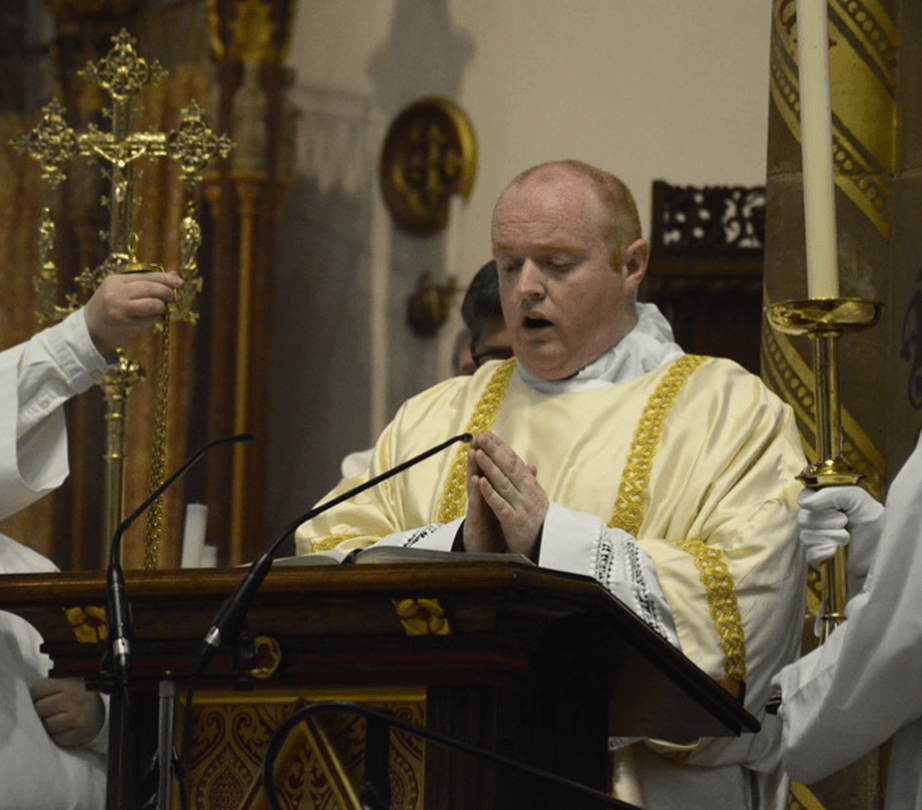
Priestly Ordination Mass of Fr Toby Duckworth and Fr Steven Fleming, 2023. St Chad’s Cathedral, Birmingham.
An Image of Christ the Servant:
The word deacon comes from a Greek word which translates as servant. It should be no surprise therefore that many of the deacon’s liturgical functions appear to be acts of service at the altar. The deacon prepares the altar and adds wine and water to the chalice with the quiet words “through the mystery of this water and wine, may we come to share in the divinity of Christ, who humbled himself to share in our humanity.” He then hands the paten and the prepared chalice to the priest in turn. Depending on the celebrant’s wishes the deacon may also cover and uncover the chalice as needed, and turn the pages of the Missal for the priest. The deacon also elevates the chalice for the conclusion of the Eucharistic Prayer, though he does not sing or say the words – they are still a part of the Sacrifice of the Mass, which is the function of the priest(s) who is (are) celebrating the Mass; instead he joins with the rest of the people in acclaiming the Lord in the final Amen. After Holy Communion the deacon can, if the priest wishes, purify the sacred vessels and return everything to their proper places.
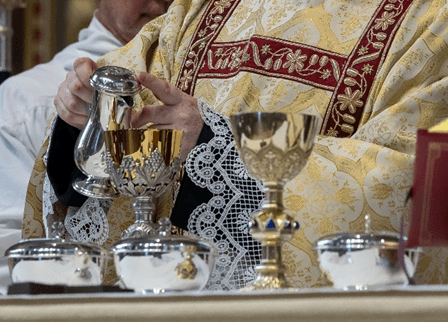
My Ordination Mass, 2022. St Chad’s Cathedral, Birmingham.
On the Distribution of Holy Communion:
A mention should be made here of the distribution of Holy Communion. A deacon is an ordinary minister of Holy Communion. This means that the Church allows him to distribute Holy Communion by virtue of his Order, without a special commissioning, such as that required to allow lay people to serve as extra-ordinary ministers of Holy Communion. However, a deacon receives Holy Communion just like a lay person, from the hand of another minister – usually the celebrant of the Mass. The celebrant of the Mass will usually distribute Holy Communion, but there is a question, it seems, of who should be the ‘second’ minister of Holy Communion if both a deacon and a concelebrant priest is present. I have not been able to find a clear and satisfactory answer to this question, but my opinion would be that if there are concelebrating priests present, the intimate connection between their Order and the Blessed Sacrament would suggest that they should distribute Holy Communion before the deacon(s) of the Mass.
Since my ordination a couple of people have asked me why I receive Holy Communion on the tongue, when I am about to distribute it with my hands. I hope that this note has addressed that: priests communicate themselves; my own reception of the Lord is from the hands of the priest. That did not change with my ordination as a deacon, despite my being in the privileged position of having the faculty to then aid the priest if needed in the distribution of Holy Communion to the faithful.
As the Link between the Altar and the Faithful:
The deacon has a number of little phrases to say aloud during the Liturgy. The most noticeable is the dismissal at the end of Mass – “go forth the mass is ended,” or one of the other options available in the Missal. There are others, such as the instruction to “bow down for the blessing” before a solemn blessing, or the repeated “let us kneel” and “let us stand” during the solemn intercessions on Good Friday. These instructions can seem rather curt and even rude, but the English translations are actually rather toned down; the literal translations are very clearly instructions. For example, the single word instruction levate, translated as “let us stand” would more strictly be simply “stand up.”
Translations aside, it is a fair question to ask why it falls to the deacon to give these announcements. The answer is simply that deacons are a link from the altar to the people, and vice versa. The celebrant addresses the people at different points in the Mass, such as with the words “the Lord be with you;” “pray brethren that my sacrifice and yours…;” or “behold the Lamb of God…;” but when instructions are to be given, it falls to the deacon to give them. This is also the reason why, after the priest has incensed the altar, it is the deacon’s role to incense in turn the priest, other clergy (usually concelebrants), and then the congregation in the main body of the church.
Another aspect which emphasises the deacon as the link between the altar and the people is the reading of the Universal Prayer, or ‘Bidding Prayers.’ While this is a role proper to the deacon, in many parishes a lay person reads these intercessions and a pastoral reason is given for this, usually something along the lines of ‘that’s what we always did before we had a deacon.’ I am not, and have never met a deacon who is, particularly precious about reading the Bidding Prayers at Mass, but the principle of praying at the altar for the needs of the world definitely fits into this meaning of the diaconate.
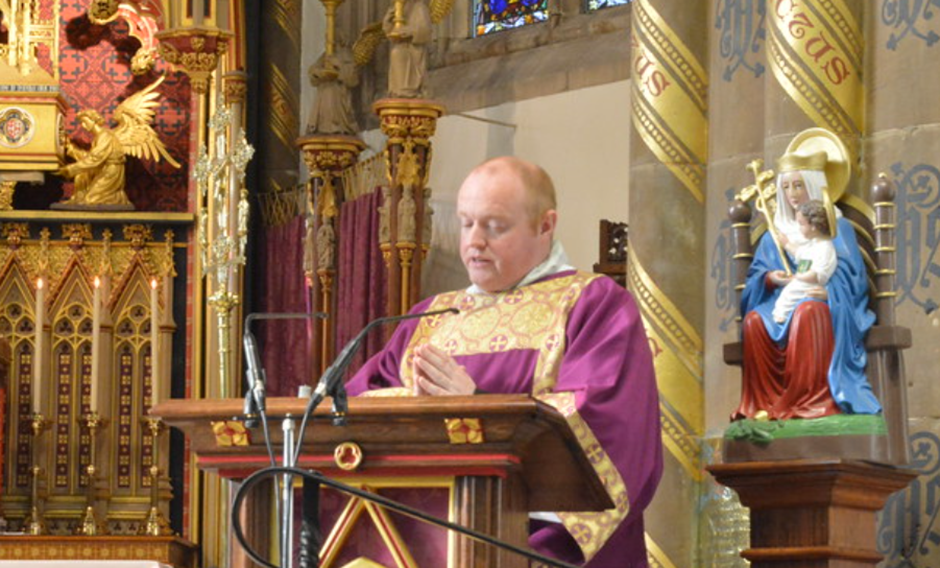
Rite of Election, First Sunday of Lent, 2023. St Chad’s Cathedral, Birmingham.
Conclusion:
This post has not taken a toothcomb through the Liturgy to examine every thing a deacons says or does, but it has covered most of them. What I hope it has achieved is to draw out some of the unique theology of the diaconate as one of the Holy Orders, and demonstrate how these aspects are expressed at Holy Mass.
With every blessing,
Martin
* Note: That quote is taken directly from my letter of appointment, and so refers to ‘the Archbishop’ as I live and minister in an Archdiocese. Everything said in relation to a bishop applies to any local Ordinary, whether a bishop or archbishop.
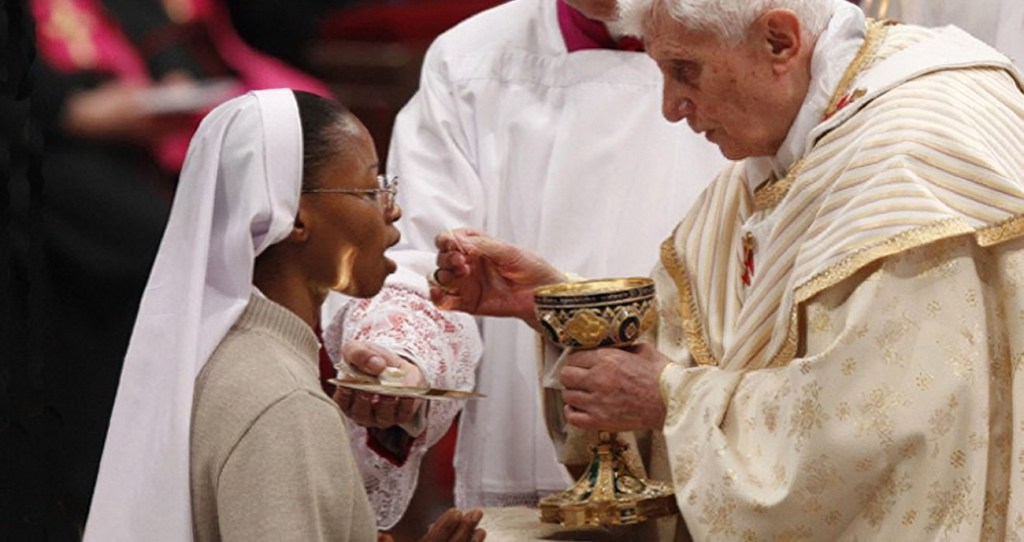
 Lk 22:27