Homily for the Epiphany: We are the Magi of today.

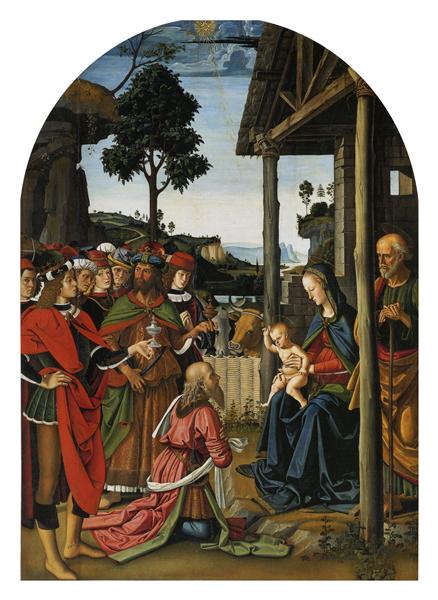
Adoration of the Magi by Pietro Perugino

Audio Recording:

Text:

The relationship between Christmas and today’s Feast of the Epiphany is complicated, but despite the appearance of wise men in many nativity plays, it is important not to fall into the trap of thinking that it is simply an extension of the Christmas story. In fact, in a very important way, Christmas and the Epiphany can be seen as opposites to one another:

Christmas emphasises the humanity taken on by the divine godhead in coming into the world. What could be more human than the tiny, helpless babe of Christmas night? Epiphany on the other hand reveals the divine nature of that child and the man he grew up to be. Adoration, sacrifice, miracles – these are things associated with God, not a human person. Even the word Epiphany means a revealing or an appearing. Today we are seeing the Christ-child in a new light. Christmas showed us the human baby Jesus, Epiphany unveils the Son of the God, the second person of the Trinity.

The readings today put the emphasis very much on the Magi who came to Bethlehem, but Sacred Tradition gives us three revelations to consider: The Magi, certainly; but also the Wedding at Cana, where Jesus revealed his divine power through the miracle of water being turned into wine; and the Baptism of the Lord, at which the three parts of the Trinity are revealed together.

At 12 noon: If you pay particular attention to the words of the first two verses of our offertory hymn you will see the emphasis placed on these three events.

But as today’s liturgy focuses on the revelation offered by the Magi, let us see what we can discern about them. The short answer to ‘what can a group of two thousand year old astronomers teach us about the Christian life?’ is simply ‘everything.’ But perhaps we should dig a little deeper into two aspects of this mystery.

One of the running themes through our readings is that of light: The first reading is a great prophecy of Isaiah: Arise, shine out, Jerusalem, for your light has come. The Gospel tells of the famous star that filled the Magi with delight. This light is a symbol of divinity, and it leads the Magi, eventually, to the humblest of circumstances. When they arrive and go into the place where the child is, we get none of the displays of knowledge or the talkativeness that they displayed back in Jerusalem. They know that they are in the presence of the divinity that the star was leading them to. They simply and silently fall to their knees, and worship him, and make an offering to him.

The second running theme is that of the revelation to the nations. These men were not Jews, yet they recognised the divine when they saw it and took news of what they had seen back to the lands they came from. They are the all who are assembling and coming towards God’s house in the first reading; they are the all nations who shall serve him from our psalm. They are what St Paul describes as the pagans who now share the same inheritance. In fact, they are us.

Two thousand years on we are the Magi of the world; and like them we are called to do two things. To take the first theme, do we recognise the divine when we see it? Do we recognise in the Holy Sacrifice of the Mass, and in the tabernacle, the Body and Blood, Soul and Divinity of Christ? Do we truly experience the same divinity in this place, our chuches, that the Magi recognised in that infant in his mother’s arms? If we do, how can we do anything other than fall to our knees and worship him? We do not need to offer the symbolic gold of a king, the frankincense of a priest or the myrrh of the dead. We are asked for something far more profound. In the words of the carol: If I were a wise man, I would do my part, but what I can I give him… give my heart.

As for the second idea; do we take the light of the Gospel to the nations today? We do not need to be setting off for the Missions to spread the message of Christ. The Lord knows there is enough darkness in the world, even in our own country. So much so that it can sometimes seem hopeless to be a Christian in the modern world. But to go back to John’s Gospel from Christmas morning: The light shines in the darkness, and the darkness cannot overcome it. We live in a privileged time, a sacramental age when our Baptism causes Christ’s light to shine through us. As we, or our parents, were handed our baptismal candle we were told that this light is entrusted to [us] to be kept burning brightly… keep the flame of faith alive. All we need to do is cooperate with the graces of our baptism and we can be a sign to the nations.

It is the time of year for resolutions and practicalities. Perhaps this year we can, every one of us, resolve to more fully appreciate the divinity of the Lord in the Blessed Sacrament; could you arrive ten minutes earlier for Holy Mass, and take the time to kneel (if you are able) and worship him as the Magi did; or perhaps you could make a special effort to visit the Lord during a time of Adoration; or even commit to a regular time each week?

And what of sharing our light? I sometimes hear people say they are embarrassed about public expressions of the faith, even within their own families. The message of the Epiphany is: don’t be! I’m a big fan of St Therese’s adage to ‘do the little things well.’ So do that – the little things: leave the crib up until the Presentation on the 2nd February; put that Child of Prague statue in the front window; bless yourself with a drop of holy water when you enter and leave the house; openly call to St Anthony when you’ve lost your keys; write and talk about the Epiphany blessing over your door. There are so many little things that we can do. Now me, or any one you, doing these things, won’t change the world. But if Kings Heath (and the Maypole) had 600-odd people all offering small acts of faith, and across the earth 1.4 billion people were doing them, what a wondrous light we could shine into the darkness; what a wonderful witness we could be the world. Even the wise men might not be a patch on us then.
What the Magi did not say…

It is often pointed out that the character of St Joseph never speaks in the Gospels. His earthly fatherhood is one of silent constancy. Without the words themselves we still see a man of faith, who trusted in the messages given to him by God; and in that faith he was able to love the Lord. There is a great deal of good in his silent example alone, but this Epiphany a connection occurred in my mind between St Joseph and the lesson of the Magi. Credit must go to my school’s chaplain for prompting this connection in something he referred to in his Epiphany homily, 2023.

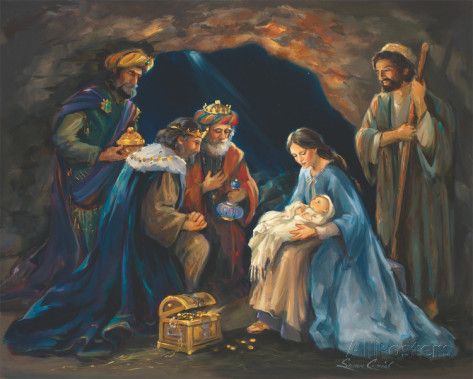
Image: Wise Men Seek Him by Susan Comish

The Magi’s journey would not have been easy for many reasons: the distance; the weather; the dangers of robbery and so on. One of the difficulties not often considered would be language. The Magi were educated men, and when they came searching for the infant King of the Jews they logically went first to Jerusalem. There they conversed with the great and the good; learned scholars who had spent their lives in the study of various disciplines, and of course, King Herod himself. Aramaic was not a widely known language, so it is likely that these conversations took place in a common language such as Hebrew, Greek or Latin, or through court translators. The Magi would have been prepared for this; they would have known how the courts of great men worked, and the etiquette to be followed. They asked their questions and were honest in the answers they gave to Herod’s questions in return. But then they were pointed to a small town south of the city; there would be no scholars or translators there.

And so comes our parallel with the silence of St Joseph. The talkative Magi of Jerusalem do indeed find what they sought. “Going into the house they saw the child with his mother Mary, and falling to their knees they did him homage.” St Matthew puts no words into their mouths now. Perhaps a difficulty of language rendered conversation impossible; perhaps they were struck with a divine awe; perhaps there was an awkward and unrecorded conversation of sorts. Whatever the truth of that visit, St Matthew chooses to recount their visit as an example of silent homage to the Christ-child. They knew that this child was something special. Psalm 111 teaches that “the fear of the Lord is the first stage of Wisdom.” It seems from their visit to Jerusalem that their knowledge of the Jewish scriptures was lacking, but if proof of the Magi as ‘wise men’ were needed, we should have all we need in the way that they fell to their knees in silent wonder.

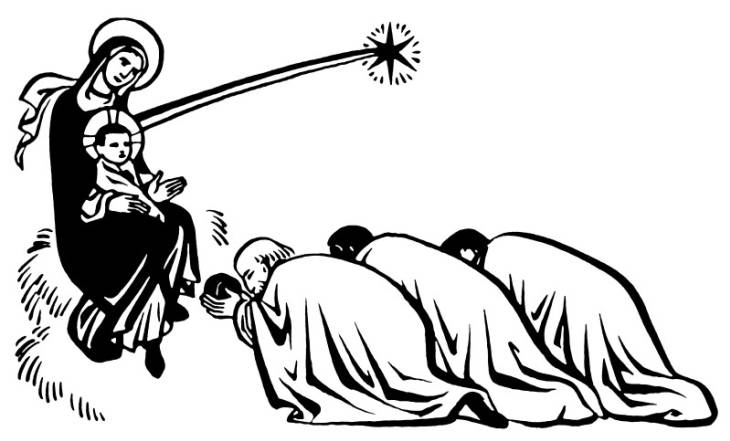
Image: Wise Men Adoring Christ Child by Ade Bethune

From the earliest days of the Church silence has been recognised as a powerful thing. The Lord himself would retreat into the wilderness alone or with his disciples to pray and commune with his Father. John the Baptist, the desert fathers and medieval hermits all recognised that the Lord could be found in the quiet of the wilderness. Contemplative religious orders spend much of their time in silence listening for the Lord’s guidance and praying for the needs of the world without distraction.

Of course for those of us in the secular world, noise is a constant. Sometimes that is external noise: cars, music and conversation around us; but sometimes it is the noise of our own minds, which cannot switch off from the cares and worries of daily life. Fortunately as Catholics we have a beautiful solution to this. Adoration of the Blessed Sacrament, whether at Exposition with the Lord in a monstrance or of the reposed Sacrament in a tabernacle, gives us time to remove ourselves from the noise of the world. Any church provides the respite from the external noise, but releasing our own minds is far more difficult. I do not intend to give a list of exercises for quietening one’s mind in prayer here, but I will suggest that it takes practice, and we should not be disheartened or put off because we find it difficult to let go of our earthly worries the first time, or consistently every time we try.

What we can and really must do, is make the effort. While our internal journey is very different from the travelling of the Magi, it can seem just as difficult. What we can be assured of however, is that it has the same end; to offer our true and complete homage to the one Lord and Saviour. We can be sure that whenever, and however often we come to him, the Lord will be waiting for us: “Jesus Christ is the same yesterday and today and forever.”

Homily: Mary, Mother of God

Today we keep the octave day of Christmas, which in the Church’s calendar is given to Mary as the Mother of God. This title is very simple to say, but is arguably the most significant out of all of those given to Mary; so much so that it caused much discussion in the early Church.

Many of you will know that I am something of a pedant, and I will happily have an hour’s discussion over the use of a single word or comma. I suspect therefore that I would have greatly enjoyed the Council of Ephesus, at which two great characters of Church history battled it out over a single word. On one side was a character called Nestorius, who argued that Mary’s motherhood was simply linked to the humanity of Christ; so, without disrespect, she should at best be considered the Mother of Christ. On the other hand was St Cyril of Alexandria who pointed out that as Christ’s humanity and divinity cannot be separated, Mary was not only Mother of the human Jesus, but the Mother of God, in all his divinity.

As you can tell from the name of today’s Feast, and his sainthood, St Cyril won the argument, and Nestorianism was declared a heresy in the Church. This is why today the universal Church recognises the mother of that tiny child in the manger as the Mother of God; the same God who spoke to the patriarchs and prophets; the same God we hear speaking to Moses in our first reading.

St Paul tells us today that it is through the incarnation of Christ that we have all become adopted as sons and daughters of God. That of course means that we have become Mary’s children too. This does not in any way equate Mary with Almighty God, as some protestants would suggest. We revere Mary for her role as the first believer in, and the first adorer of, the Christ-child. In this she is the perfect image of all believers, but just like all believers her own salvation comes only through the grace of God.

But it is not Nestorian to remember also today the normality of Mary’s role in the childhood of the Lord. Jesus was God, but he was also a defenceless child. He had his mother, Mary, and his earthly father, Joseph. They loved him, and cared for him, and raised him; in a very normal and human way.

In the run-up to Christmas, I was lucky enough to go into one of my parish’s schools and decorate a Bambinello with my son. That baby is now in our nativity scene at home, where it will stay until Candlemas. After that it may be put away with the Christmas things, or it might go into his keep-sake box.

I suspect most families will have, somewhere in their house, a keep-sake box for their children. A gradually expanding collection of school reports, certificates and artworks. As important as they are, these physical objects hold value to us for the occasions that they bring to mind. Opening that box is a way of remembering those memorable times, some of which we might otherwise have forgotten.

The most important occasions, of course, it would be impossible to forget even if we tried. For those of us who are married, our wedding day is probably one. For those who are parents, the days of our children’s births will be others. Of course, such events may not always be positive; the loss of a loved one or the discovery of an illness can be just as memorable, albeit in a very different way.

Memories though, however vivid, are only ever in our minds; to truly reflect on them, on emotional and spiritual levels, we must use our hearts. This is what St Luke means when he says that Mary ‘treasured these things and pondered them in her heart.’ She knew that what was happening in that stable of Bethlehem was important. It was life-changing for her, as any mother knows, but it was more than that. This child was going to change the world. How, she did not understand; but her ‘fiat’ went far beyond simply carrying and birthing this child that an angel had called the Son of God; she was now the mother who would raise him. Theologians’ arguments aside, she was – and she knew she was – even in that humble stable, the Mother of God.

Some people prefer a sanitised view of the Christ-child and Mary’s care for him. The child described in the carols: ‘Christian children all must be, mild, obedient, good as he.’ The reality however must have been different: Christ embraced our humanity in everything but sin; so how did he tell Mary that he was hungry, or that his nappy needed changing? He would have cried, like any baby. How did he grow and learn all the things that everyone has to learn? He learned by asking his mother.

In contemplating this normality of the Lord’s upbringing I was reminded of a Catholic cartoon which goes around every so often on the internet with the title ‘Jesus prays the first rosary,’ or similar. The image shows a young Jesus looking up at Mary and tugging at her skirts while repeating over and over ‘mum, mum, mum, mum, mum…’ A very normal thing for a lot of mothers and their children.

[For those reading online a copy of this image is below]

We are the spiritual children of Mary, so we should have no fear of turning to her in our need just as the child Jesus did. And yes that means sometimes being that child and repeating ever more fervently ‘mum, mum mum!’

I think it is right today to finish by asking our Lady, our heavenly mum, to lead the saints and angels in intercession for the repose of the soul of dear Pope Benedict.

Mother of God, all Saints of God, come to his aid; Hasten to meet him, angels of the Lord. Receive his soul and present him to God, the most high.

The Immaculate Conception

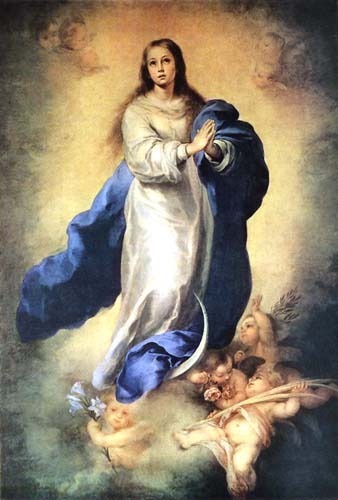
Immaculate Conception, Murillo, 1660

When Pope Pius IX defined the dogma of the Immaculate Conception of the Blessed Virgin Mary (Ineffabilis Deus, 1854), he was enshrining for all time a belief which had already been held for well over a thousand years.

The biggest misconception (no pun intended) regarding the Immaculate Conception is to confuse it with the Annunciation. Today’s feast refers to the conception of Mary herself, not the conception of Christ as announced by the Angel Gabriel. It may seem that the choice of the Annunciation as today’s Gospel is a curious choice then; surely it will just encourage confusion. However, as we will see, that beautiful interaction tells us not just about Mary’s future, but also reveals something crucial about her past.

Mary’s conception and parentage are not described in the Gospels (though ancient tradition gives her parents’ names as Joachim and Anne, whose feast day is the 26th of July.) What we know of Mary from the Gospels is that she became the Theotokos – a Greek term usually translated as ‘God-bearer’, or more familiarly, ‘Mother of God’. Neither of these translations quite do the term justice however; because the first implies that Mary was simply a tool which God used, in the way one would ‘bear’ water in a jug, whilst the second emphasises the humanity of Christ over his divinity. To the early Church, the term Theotokos referenced her privileged role, whilst emphasising the combined humanity and divinity of the person of Christ (the ‘hypostatic union’.)

That last sentence sums up how we should consider Mary’s example, and to a lesser extent all of the saints. We refer to them in order to emphasise aspects of the God we worship. We consider their example and ask their intercession in order to bring ourselves closer to God. In our Lady’s Immaculate Conception we see the infinite goodness of God as salvation history approached its high point in the Incarnation, and ultimately the Death and Resurrection, of the Lord.

The first reading at Holy Mass today is the account of the sin of Eve and the consequence of Original Sin for all of her descendants. It is easy to see in this passage the vengeful God one often expects of the Old Testament, but even here God shows his immense love and his ultimate plan for salvation. Both Jews and Christians see in this passage the first prophecy of the Messiah:

“I will make you enemies of each other: you (Satan) and the woman (Eve/Mary), your offspring (sin and death) and her offspring (Christ). It (Christ) will crush your head and you (sin and death) will strike its heel.”

The place of Mary, the new Eve, in opposing Satan in a way which the original Eve could not, dates back to at least St Justin in the mid-second century. So what set Mary apart from Eve, and indeed every other woman ever born? For the answer to this we must refer to today’s Gospel, and arguably the most commonly spoken Christian prayer.

The word angel means ‘messenger’; they speak on behalf of God. In greeting Mary the Angel Gabriel said, “rejoice, so highly favoured! The Lord is with you.” Perhaps a more recognisable translation would help: “Hail [Mary], full of grace. The Lord is with thee.” It is a shame, in my humble opinion, that the translation used in the Lectionary varies so much from the Latin and Greek here: ‘gratia’ should clearly be translated as ‘grace’; and ‘ave’ is a greeting, not a suggestion to ‘rejoice’. The original Greek makes this even clearer: it uses a verb meaning ‘endow with grace’ (κεχαριτωμενη/kecharitomene) in the perfect and passive, which means that the Angel did not bestow God’s grace upon Mary there and then, but that she had always had the graces needed to lead her to this point and those needed to fulfil her role from this moment onwards. Our answer then is that Mary was possessed of graces that no other human, before or since, has been given. This is what we affirm every time we say the Hail Mary: She was truly full of grace.

While the Council of Trent (1545-63) had acknowledged that Mary was graced with a life free from sin, Pope Pius IX clarified the Angel’s words as meaning that Mary was also free from the Original Sin caused by the sin of Eve. This immaculate nature – an existence without stain or blemish, was necessary for her to be the Ark of the New Covenant, the Mother of God, the Theotokos.

Christus Vincit, Christus Regnat, Christus Imperat

Christ the King 2022 (Year C)

The words Christus vincit, Christus regnat, Christus imperat – Christ conquers, Christ reigns, Christ commands, are carved into the obelisk which stands in St Peter’s Square in the Vatican. That obelisk was placed there by Pope Sixtus V in 1586 as an eternal memorial to Christ the King.

Obelisks carried connotations of the divine from their earliest days. To the Egyptians the shape of what they called a tekhenu was reminiscent of the benben – the mound on which their creator god stood during the creation of the world; the living deity that was their Pharoah, and curiously, a bird which represented both the beginning and end of the world. Today’s second reading makes it clear that the Lord is eternal; “before anything was created, he existed.” He will be there too at the end of all things, the Lamb of St John’s Revelation. The Lord is the living God, “consubstantial with the Father” in the Holy Spirit. As such he is the fulness of revelation and the aim of human faith.

To the later Romans the Egyptian obelisks took on a different meaning. They were removed to Rome and erected as monuments to the victories of the god-emperors. The obelisk which stands in the Vatican carries an echo of this meaning even to this day. It was first transported to Rome by the emperor Caligula and placed outside the great circus he had built on the site where St Peter’s Basilica now stands. When it was moved in the sixteenth century to its current position it was exorcised and blessed as monument to Christ’s victory over even the most influential secular powers.

Today’s Gospel may seem an odd choice for today’s feast; but it has two important messages for us as we consider the sovereignty of the Lord. Firstly, it reminds us that Christ’s kingship extends far beyond what we can understand. His promise to the good thief that “today you will be with me in paradise,” is more than a promise of heaven. It shows the Lord’s authority to promise heaven. Anyone can say the words of a promise, but without the power to fulfil that promise, it remains only words. As Christians we take the Lord’s authority to fulfil his promise as an essential part of our faith – he is the Word made Flesh, Truth Incarnate; in the words of a hymn by Thomas Aquinas, “Truth himself speaks truly, else there’s nothing true.” Christ’s authority then, extends not just to the miracles and wonders he worked in our world, but unto the end of time and beyond, to the paradise which awaits all the faithful.

Secondly, the crucifixion is given to us today as a reminder that all authority in heaven and on earth has been given to him precisely because of the Cross. Even as mankind committed deicide, the greatest of sins, he felt nothing but love, offered nothing but redemption. His is not the kingship of a tyrant, ruling by fear and oppression, but one of charity and benevolence. As Catholics we understand every mass as making present the sacrifice of the Cross; at each Eucharist the Lord comes to us as his Body and Blood. As we attend mass this Sunday and behold the elevated host and chalice, let us share in the prayer of the good thief, “Jesus, remember me;” and be assured that in his divine majesty, he will.