
Audio Recording:
Text:
You may be familiar with the TV programme Gogglebox, but for those who aren’t the premise is that various videos are shown to groups of viewers, and their reactions are recorded. I can’t claim to be a regular watcher, but I would very much like to see a Catholic edition of Gogglebox, in which we get to see people’s reactions as they hear the messages of the Gospel for the first time.
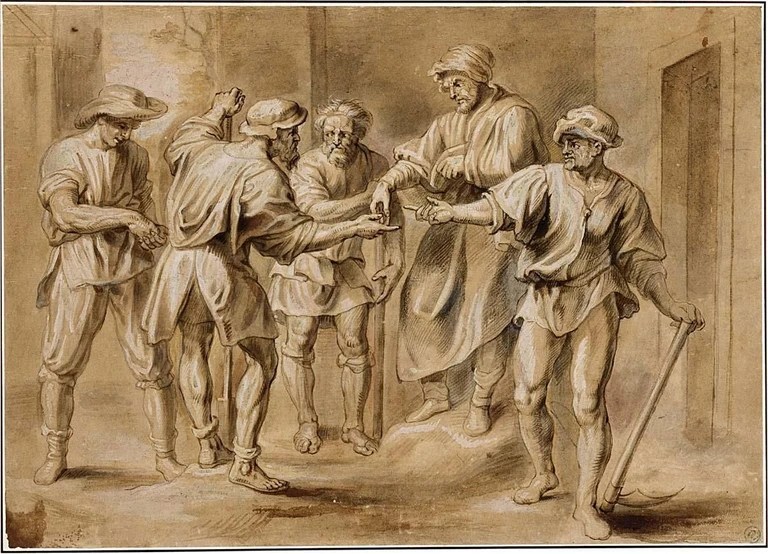
I suspect today’s parable would be a hit on a programme like that. It’s hard not to find ourselves thinking ‘do you know what, fair play to the whole day’s workers for moaning – they had done the full day’s work after all.’ People on the show might be nodding their heads in agreement, only to find themselves with furrowed brows and perplexed expressions when the landowner calmly explains that those workers got exactly what was promised. The only thing that could be being criticised here is his generosity, and generosity’s a good thing, surely?
In a time when we are very aware of social justice, this parable really can seem unfair; but we need to remember that it is just that – a parable. The examples used in parables are illustrative – the message of The Good Samaritan is not limited to mugging victims, nor is the Parable of the Ten Bridesmaids about the logistics of owning oil lamps. In the same way, we must not read an earthly sense of fairness into today’s message – the pay received by all represents eternal salvation, and what could we possibly hope for beyond that?
The first failing of the workers then, is that they see long-service as entitling them to more than those who took up the landowner’s offer at the eleventh hour. It would be easy to use the words of our first reading to explain God’s mercy as being a thought beyond our comprehension, but it is worth remembering here that Matthew was writing his Gospel for a Jewish audience; and as we heard in the Gospel of his Feast Day this past Thursday, the Jews generally were far from keen on embracing anyone that they did not believe was part of God’s chosen people. In fact, this parable is only recorded in Matthew’s Gospel, perhaps he intended it as a thinly veiled message that those who come to God through his Christ are just as entitled to his mercy as those who followed the Law of Moses. On our shorter time scales, of course, we must remember that having been Christian for a lifetime does not entitle us to more than a death-bed convert. There are no VIP rooms in heaven, and it would be vanity to hope for such.
This brings us neatly to the other failing of the workers in our Gospel – their selfish sense of their own value. Being made in the image and likeness of God, we do of course have an innate dignity and worth; but forces in today’s society have managed to corrupt this ideal. I love rugby and I’ve been watching a great deal of the World Cup in recent weeks. Many of the advertisements shown in those programmes are typical of exactly this corruption. One of them in particular barely advertises a product, instead it glorifies the message that as long as we are doing what we want to do, nothing else seemingly matters. This is not the Christian understanding of individual worth and value. We are called to embrace our distinctiveness, within the Gospel message; and then to place it at the service of others – St Paul understood this in our second reading. He longed to die and reach his eternal reward, but he also knew that, in his words, “living in this body means doing work which is having good results.” Those good results were most apparent in the lives of others, not in his own.
Another of those adverts is for the British Army, with its tagline “be the best”. But if you told me that I was the best person, the best Christian in this church this morning, I would not be pleased. To aspire to being the best means to embrace life as a competition with others, and as long as I am better than them, I can be happy. For the army it make sense as a slogan; in war being better than your opponent is what keeps you and your comrades alive. Being the best is enough in their profession. But you and I won’t get to heaven simply by trying to be better than everyone else.
To put it bluntly, being the best isn’t good enough; it isn’t what being a Christian is about. I don’t want to be the best. I want to be perfect – perfect enough to spend eternity in the presence of my God and Lord. With the grace of God I will get there; but I fully expect, like Gerontius in St John Henry Newman’s famous epic, that I will have to beg my guardian angel for the purification of purgatory when the time comes.
But that’s not me trying to ‘be the best;’ because I want that same perfection for every single one of you, from the youngest child who hears this to the oldest pensioner. And beyond that, I wish it and pray it for all of humanity in every age of the world. That is what it means to be a Christian. I can be me, and you can be you, but we can do it selflessly and still live the lives that God wants for us. Life is not a contest. We can, all of us, attain perfection, in this world or the next. And we know that we can do it because, in the words of the psalmist today:
The Lord is kind and full of compassion…
He is close to all who call him,
Who call on him from their hearts.


 Lk 22:27