
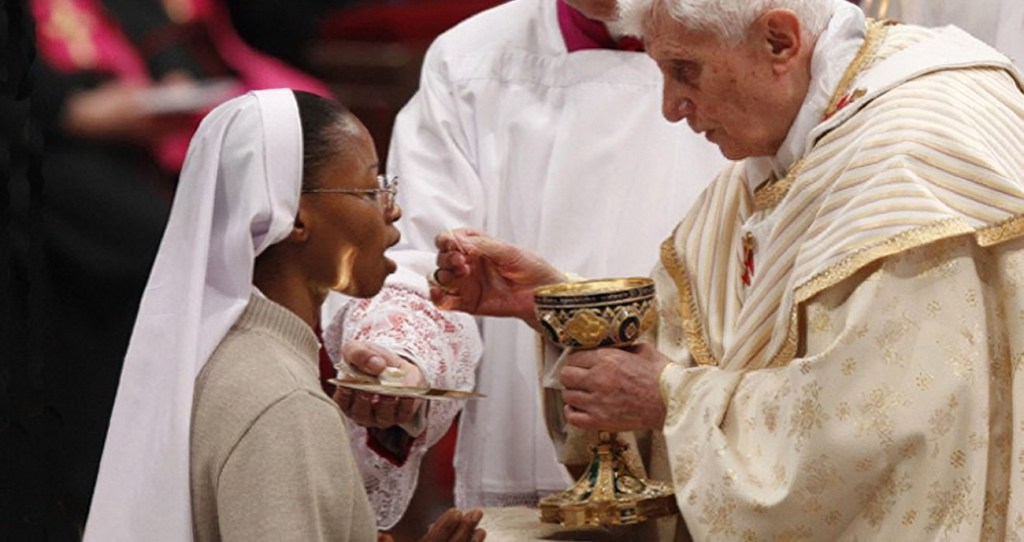
This is a somewhat longer than normal post, as it is a response to a question I was asked earlier this week about how often it is right to receive Holy Communion. The question was asked by a man who currently goes to daily mass, but usually only receives on a Sunday. His reason for this being that he feels that he doesn’t always have time to make an honest thanksgiving after receiving at a weekday mass.
His question spurred me to some reading on the changing practices of the regularity of Holy Communion over the years and some prayer and reflection on the practice as it exists today in Western Europe. What follows is a summary of my thoughts and an attempt to give a considered opinion on how one might view regular and daily Holy Communion.
Let me begin by stating clearly and unequivocally: We should attend Holy Mass and receive the Lord in Holy Communion as often as we are able to. The Blessed Sacrament is our God made present: Body, Blood, Soul, and Divinity; and Holy Mass is the highest form of prayer and praise that we can be part of this side of heaven. However, as we shall see, being able to is not synonymous with simply having the opportunity to.
In the scriptures there are implications that the early Church in Jerusalem received daily, but they are open to some interpretation. For example, Acts 2:46 describes the faithful meeting every day in the temple courts, but leaves it to the next sentence to say, “they broke bread in their homes and ate together.” This is describing the very early origins of the Sacrifice of Holy Mass but is removed in language from the daily gathering in the temple. Later in Acts (20:7), Paul describes coming together with the young Church at Troas “on the first day of the week… to break bread;” but again, it is unclear whether they only did this once a week, or more regularly.
The Fathers of the Church seem to be divided; the Didache and St Justin point to only receiving on a Sunday, whilst St Cyprian, St John Chrysostom and St Ambrose are among those who describe daily communion as a common occurrence. Many of the Fathers are neither supportive of nor resistant to daily communion. St Augustine simply decribes that “some receive the Body and Blood of the Lord every day… others on Sunday alone;” while St Jerome writes, “of [daily communion] I neither approve nor disapprove.”
Regardless of the practice in the early Church, what is clear is that by the Middle Ages receiving Communion had become very rare amongst the laity, to the point that the Fourth Lateran Council (1215) introduced for the first time the obligation of all the faithful to receive Communion at least once each year (in Lent, rather than the current Eastertide discipline.) The reasons that reception became so infrequent are complex and a matter for historical scholars, and there is not time to discuss them at any length here; but if we consider that mass attendance in the Middle Ages was very high in Western Europe, it does leave us with a relevant question: Why did people go to mass if they were not going to receive the Lord in the Blessed Sacrament itself?
For many, in fact probably most, Catholics, attending Holy Mass comes with an expectation of, even a sense of entitlement to, Holy Communion. Communion is a part of Mass therefore I will receive Communion. This is not the case, and is something that I believe needs challenging in the modern Church for a number of reasons:
Firstly, it leads to an expectation that everyone gets up and approaches the altar, even if only for a blessing. God’s blessing is given to all present at the end of Mass by the celebrant; there is no extra holiness to be gained by receiving a personal blessing five minutes earlier in the Communion queue. However, in the interests of inclusion and dare I say ‘active participation’ I will say no more about Communion blessings here.
Much more significantly, an expectation of Communion removes in our minds the necessity of considering our suitability to receive the Lord in his Eucharistic Body. At school masses I have heard it said, “if you are not Catholic, or are Catholic but unable to receive Communion, then please come forward for a blessing.” I have asked many Catholic teenagers after such statements if they knew what would make them “unable to receive Communion,” and the vast majority (95% and more) have no idea. I strongly suspect a similar reaction would be given by most adult Catholics today, certainly in Western Europe and North America. This almost blasé approach to our state of grace has gone hand-in-hand with a decline of our awareness of sin and the infrequency with which most Catholics now seek the Sacrament of Reconciliation (Confession).
So what were the medieval faithful getting spiritually from Mass if it was not Holy Communion? They understood that at Mass they came into the presence of the Almighty, the Holy of Holies. They knew that, to use a traditional term, they assisted at Mass, uniting their prayers and needs to the Sacrifice offered by God’s holy priest, standing in the place of their Lord and Saviour. It is easy to look down on the faith of medieval peasants and see them as a mass of religious illiterati, but while their faith may not have been educated in the modern sense, it was deep enough to keep them seeking the tranquillity and numinous beauty of Holy Mass, even if they did not receive Holy Communion every time. If we do not find the same beauty that they saw, then there is something wrong. Perhaps this can be put down to the nature of the modern liturgy, or at least its expression in certain places, but I suspect it has far more to do with our own approach to Holy Mass and our role within it. The doctrine that the faithful unite themselves and their prayers with the Sacrifice offered by the priest who stands in persona Christi has not gone away. With our vernacular liturgy the words are even there for our well-educated modern minds to follow, if we care to, and I can do no better than to quote them. Anyone and everyone reading this reflection would do well to consider and personally reflect upon the beautiful dialogue between priest and people immediately before the Prayer over the Offerings:
We stand as the priest addresses us:
Pray, brethren, that my sacrifice and yours may be acceptable to God, the almighty Father.
And we reply:
May the Lord accept the sacrifice at your hands for the praise and glory of his name, for our good and the good of all his holy Church.
One of the documents of the Council of Trent (1545-1563) stated for the first time in centuries that “at each mass, the faithful who are present should communicate.” In contrast, if not contradiction (given that the weekly Sunday obligation had existed in practice for well over a millennium), the catechism of that same council states that while regular communion is a positive thing, “whether it be monthly, weekly, or daily, can be decided by no fixed universal rule.” This certainly leaves the door ajar for regular, even daily, mass attenders to receive as and when they feel able.
In the most definitive document of our time, a decree given at the instruction of Pope St Pius X (Sacra Tridentina, 1905) quoted the Council of Trent in encouraging Holy Communion “as often as possible, even daily.” This quote, in isolation, would seem to encourage the cavalier attitude described above, and gives little regard to whether a person is in a state of grace. This could not be further from the truth. The second part of the decree gives numbered points in regard to the practice of daily Communion, and I will give the second of these points in full:
“A right intention consists in this: that he who approaches the Holy Table should do so, not out of routine, or vain glory, or human respect, but that he wish to please God, to be more closely united with Him by charity, and to have recourse to this divine remedy for his weakness and defects.”
The next (third) point specifically requires that communicants “be free from mortal sin;” and the final (ninth) point insists that there is to be no more “contentious controversy concerning the dispositions requisite for frequent and daily Communion.”
If we combine these together, we appear to reach a definitive conclusion: As long as one is in a state of grace (id est, free from mortal sin), and is receiving with the intention of coming closer to God, then one should receive as often as possible, even daily.
I turn now to my own interpretation and humble opinion.
Let us be in no doubt – the Lord wants to come to us in Holy Communion. In the words of St Therese, “Jesus does not descend in order to live in the tabernacle, but he wants to dwell in our souls.” In preparing my daughter (who is named for Therese) for her First Holy Communion I read her the passages from The Story of a Soul (Therese’s autobiography) which describe the joy that the Saint felt as she received the Lord for the first and subsequent times. In those passages, Therese shows great devotion to the Lord in Holy Communion, and laments that she cannot receive more often: “my one desire was for Holy Communion, which was allowed to me on all the great feasts. Alas! how far apart they seemed!” No doubt Therese was prepared and well-disposed for those occasions when she received the Lord; we are called to feel that same desire. We mustn’t see the saints as unobtainable and unrealistic ideals – there is nothing to stop us feeling the same devotion as St Therese except our own selves. Remember, the Lord wants to come to us, do we truly want him?
We are blessed in our part of the world and our time that we have regular local Mass, and readily available transport to get us there. There have been many occasions in the history of the Church when this has not been so; consider the early persecuted Church, recusant England, Soviet gulags, the oppression seen in Africa and China today. I think particularly of a story told to me by a parishioner (and who has given her permission to share this anecdote) who described living in Saudi Arabia fifty or so years ago. Being a priest was illegal and often they would go months without one visiting. When a priest did come, clandestine Masses were said in private houses and the Blessed Sacrament was reserved with great secrecy in a person’s home. Whilst I admit I found the image of her genuflecting each time she passed her freezer rather amusing at first, in that situation we cannot help but consider the Blessed Sacrament for what it really is. Simply being caught with it would have seen that lady and her husband sent to prison, yet they took the risk so that our Lord could be present in that place and be brought to those who needed him. Do we consider Christ in the same way as shuffle forward in the queue at every Mass we go to? Or do we sometimes take Holy Communion for granted?
No one can judge whether in their heart a person presenting themselves for Holy Communion truly seeks to come closer to God, perhaps least of all the minister administering the Sacrament. Leaving aside the controversies of those in public and manifest grave sin such as have enveloped the Church in the United States, if a person comes forward for Holy Communion, then it should be given. The judgement should be made by the communicant themselves. However, for that judgement to be genuine, the faithful must be aware, and indeed in awe of, that which they are approaching, and what exactly it is that they are asking for. Again, this could not be plainer in the Ordinary Form of the Mass, if we care to consider the words used. Literally, “the Body of Christ;” to which we affirm, “Amen,” it truly is.
Personally, I do not always receive the Blessed Sacrament at Holy Mass, and I do not consider myself scrupulous for admitting to myself, upon examination, that I am not in the right state of mind to receive my Lord in that way today. If I truly believe myself to have fallen from a state of grace through mortal sin then I avail myself of Confession as soon as I possibly can, and this has been in the sacristy minutes before Mass. Far more commonly though I feel rushed in my preparation; or distracted during Mass by other things I have to do; or annoyed at something that has happened that day. I still do my best to assist at that Mass; to unite my prayers to those of the community and to the Sacrifice of the Mass. I still leave with a sense of fulfilment, knowing that I have spent time with my Eucharistic Lord and have drawn closer to him than when I walked in. In that regard it perhaps feels similar to attending Adoration.
The essence of this is that if we consider ourselves able to receive the Lord at any particular mass, then we should. It is not about being worthy, because no one is worthy of the love that Christ showed when he gave us his Body and Blood in the Eucharist; but we can decide for ourselves whether this is the right time to unite ourselves with the Lord in that most perfect way. If we receive by habit or routine, or when we feel distracted or rushed, or if we doubt our state of grace, then we offer our Lord nothing but human contempt in return for immeasurable love.
I do not share these thoughts in an attempt to dissuade people from daily Communion. Quite the opposite in fact. If in reading this you are truly upset at the thought of going without the intimacy of Holy Communion, then be happy, because your love and desire for the Blessed Sacrament has a depth that I fear many of the faithful today lack. If, when you examine your own heart, you see something of yourself in the routineness or distraction I have described, then consider kneeling in silent prayer during communion at just a single mass. Your yearning for our Eucharistic Lord will grow and you may find yourself spurred to a true conversion of heart in an aspect of life that has kept you from coming closer to God.
At the very least I would encourage everyone to an honest and rigorous examination of oneself before every Mass; and if we find ourselves lacking, offer up whatever it is that is keeping us from the Lord that day and recite the prayer of the Centurion through and through in our minds:
Domine, non sum dignus ut intres sub tectum meum,
sed tantum dic verbum, et sanabitur anima mea.
Lord, I am not worthy that you should enter under my roof,
but only say the word, and my soul shall be healed.
 Lk 22:27