
Psalms for Sundays
Responsorial Psalms for every Sunday Mass Using the texts of the 2024 Lectionary

Contents:
One-Click Download
Introduction
The Ilsley 1 Tone
The Other Tones
A Brief Guide to Notation and Singing
Conclusion
Physical Resource
Sample Recordings
Suggested Organ Accompaniments
Psalm Sheets – Ilsley 1
Psalm Sheets – Ilsley 2
Psalm Sheets – Ilsley 3
One-Click Download
The following is a link to a folder with a one-click download of the full resource, as a zipped file: One-Click Download
(WordPress doesn’t allow zipped files, so I’ve had to provide a OneDrive link.)
Introduction
Sing psalms to the LORD with the harp,
with the harp and the sound of song.
Psalm 98
The psalms are supposed to be sung. The Greek root of the word implies its musical origin: psalmos literally means the plucking of a harp. The General Instruction of the Roman Missal states that “it is preferable for the Responsorial Psalm to be sung” (GIRM 61) at Holy Mass, and this is to be hoped for most especially on Sundays. Sadly, this is not the case, with various reasons often being given; most frequently a lack of an accomplished cantor or time to prepare. The intention with this project, coinciding with the new Lectionary in Advent 2024, is to alleviate these two most common problems, and allow the singing of the Psalm at Holy Mass every Sunday in every church.
To that end this resource is provided free of charge to every parish that wishes to use it, and is suitably licensed in England and Wales, and in Scotland. Pages can be printed and used at will, but please do not remove the copyright notice from the bottom of each page.
In this resource you will find:
- A short description of how these psalm tones came to be written and used.
- A brief written guide to singing the psalms, including how to understand the notation used on the psalm sheets.
- Organ accompaniments for the three provided tones.
- Separate sheets for the Responsorial Psalm for every Sunday Mass, across the three-year cycle, using each of the three tones
The Ilsley 1 Tone
Origin:
In order to explain the origin of the tone, please permit a short personal introduction. My name is Martin Casey, I am a deacon and secondary school teacher in the Archdiocese of Birmingham, in the United Kingdom. Some years ago I wrote a simple two-line tone which could be used for the singing of the Gospel Acclamation at my school’s Masses. This then grew into a four- and six-line psalm tone to be used with the Responsorial Psalms.
One of the most important things as the tone developed was to keep it easy to sing, so that cantors, choirs, and congregations could pick it up easily. My school is named for Archbishop Edward Ilsley, the first Archbishop of Birmingham, and so the tone became known as the Ilsley Tone – the ‘1’ came later as other tones were written.
During the Covid lockdowns I was in formation for the diaconate. A group of my fellow students and I began to meet twice daily to pray parts of the Divine Office together; and we adopted the Ilsley tone as one of the tones used for the Benedictus and Magnificat. As the UK came out of lockdowns and churches opened again, there were restrictions on how many people could sing at Holy Mass. My parish priest asked if I would act as a cantor for some hymns, and I agreed. As we began to sing the parts of the Mass congregationally again it fell to me, along with our organist, to choose psalm tones. My being confident with the Ilsley tone made this the natural choice, and we have used it regularly since then.
The General Instruction (61) allows for the psalms to be sung straight through, without responses. While we haven’t done this at Mass, groups of parishioners have sung the Benedictus and Magnificat to this tone, without practice, at Morning and Evening Prayer. Such is the benefit of familiarisation with a tone.
Ease of Singing:
As mentioned earlier, the tone included here was written to be easy to sing.
The responses use the first and last line of the tone itself, which allows a congregation to recognise their part week by week, and to recognise when their response is about to begin. I have had comments from parishioners who, by their own admission, are ‘not musical at all’, that they can look at the response and sing it in their head, even before they hear it; they are subconsciously able to break the response into two lines and recognise their moving notes.
When sung as a four line tone (the most common), every line begins on the note that the previous one ended on. When sung as a three, five or six line tone, there is only ever one jump between lines, and it is always the same (down a tone) and always in the same place (at the beginning of the final line).
Likewise, almost all movements are a single tone or semi-tone. The only exception is in the fifth line of the tone, which drops two tones to the final note.
The Other Tones
Using a single tone regularly is a good way for a choir and congregation to learn a tone and become confident in singing the psalms. However, it does have some drawbacks: Firstly, it misses an opportunity to musically reflect the changing moods of the liturgical year; and secondly, it will seem rather samey when a celebration (such as the vigils of Easter and Pentecost) contains more than one psalm.
With this in mind, other tones were prepared and are included in this resource as Ilsley 2 and 3. Each is slightly more complex than Ilsley 1, but they follow all of the same rules on how and where to move note. Sheets for every Sunday Mass are included for all three tones, and can be used at will, but as a suggestion for those parishes ready to move to different tones at different times:
Ilsley 1: Ordinary Time
Ilsley 2: Advent and Lent
Ilsley 3: Christmas and Easter
A Brief Guide to Notation and Singing
Chanting a psalm is not the same as singing a hymn. Hymns have a certain metre; that is, they have a certain number of syllables on each line, in a certain rhythm, and a certain number of lines per verse. They also change note more often and are far more likely to be melismatic (having more than one note on a single syllable).
Understanding the Annotations:
Psalms have tones, rather than tunes. Some tones have more complex elements, but for all three of the Ilsley tones:
- Most of each line is sung on the same note, regardless of how many syllables there are.
- We will call this the reciting note.
- This is followed by two notes which apply to one syllable each.
- We will call these the moving notes.
- On the psalm sheets, the syllables corresponding to these notes are underlined, italicised and emboldened,
- Any remaining syllables are sung on a single note.
- We will call this the final note.
For example, in the opening line of Psalm 122:
I rejoiced when they said to me.
I rejoiced when they is all sung on the reciting note; said to are sung using the moving notes; and the single syllable me is sung of the final note.
Or in a line from Psalm 105, which moves mid word:
He remembers his covenant for ever:
He remembers his co-ve- is all sung on the reciting note; –nant for are sung using the moving notes; and both syllables of ever are sung on the final note.
Rhythm and Holds:
Some prefer to chant with a steady regular rhythm, but many see the rhythm as more flexible than that of a hymn; with syllables being extended and shortened as they would be in speech. To this end, two copies of the psalm sheets have been provided: The sheets and files labelled ‘Moving Notes Only’ are annotated as described; whereas the sheets and files labelled ‘Holds and Moving Notes’ have additional syllables underlined. These syllables are those that can be extended slightly to give the chant a more lyrical quality. These extensions are appropriate when: a stressed syllable falls before the moving notes; before a piece of punctuation; or otherwise at the end of a clause.
For example, from a canticle of Isaiah used on the third Sunday of Advent (C):
Sing to the LORD for he has wrought wonders.
The syllable he may be stressed in speech, and so may be extended in chanting.
Or, in the same canticle:
Behold, God is my salvation!
The syllable hold may be extended as it is before a comma.
Pronunciation:
The English accent varies significantly from place to place, and certain pronunciations may affect how the psalms may be sung. I have tried to facilitate standard enunciation in the way that I have annotated the psalms in this resource. What follows is not an exhaustive list, but some particular words to note are:
- Israel having three syllables (Is-rye-el)
- Blessed having (usually) two syllables (Bless-ed)
- Meribah stressing the second syllable (Meh-ree-bah)
- Sanctuary having four syllables (Sanc-chew-air-ree)
- Victories having three syllables (Vic-tor-rees)
- Generous having three syllables (Jen-er-rous)
Conclusion
As has been said, this resource has been written to be easy to use musically. Established parish musicians may wish to make use of it as a stepping stone to more complex settings of the new translations, or while waiting for those settings to be written; other parishes may wish to make these their go-to tones for every Sunday for the new translation; or even, it is very much hoped, some parishes may begin for the first time, or for the first time in a while, the singing of the Responsorial Psalm at Sunday Masses.
Should there be anything at all I can do to help; from written responses, to phone/video calls, to visiting your parish to get you started; please do not hesitate to contact me at dcn.martin.casey@rcaob.org.uk.
Physical Resource
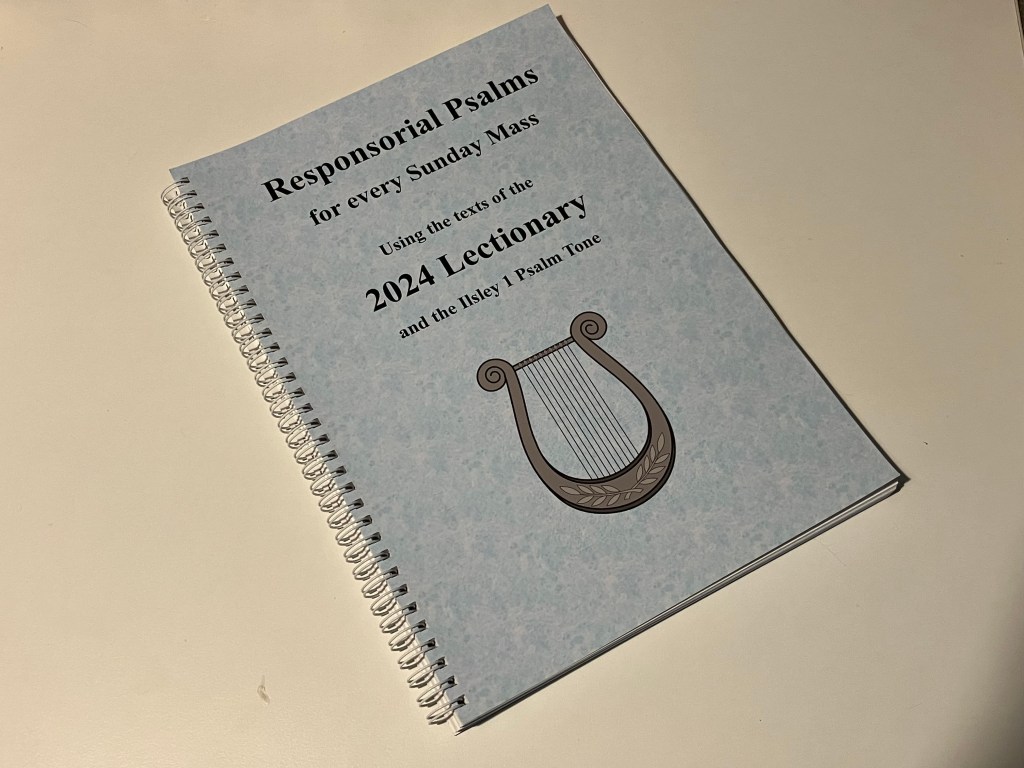
The final version will arrive as 3 volumes in different colours.
During the development of the psalm-sheets, a number of people suggested that they would prefer a set of physical books to an online resource. It has been possible to offer this as an option, but it is necessary to ask for a donation to cover the printing and postage costs. The printed resource consists of three volumes:
Volume I:
Contains the Ilsley 1 tone applied to the psalms of all possible Sundays outside of Ordinary Time.
Volume II:
Contains the Ilsley 1 tone for the Sundays of Ordinary Time (for all three years).
Volume III:
Contains the other Ilsley tones as alternatives to all possible Sundays outside of Ordinary time, according to the character of the Psalm.
Each volume:
+ Contains between 100 and 114 individual psalm sheets; each with the tone notation, line-guide and annotated text.
+ Begins with a introduction and guide to chanting the psalms, and the notation used.
+ Includes a copy of the suggested organ accompaniments.
+ Is printed on durable A4 pages in an easy-to-read, size 16 font.
+ Comes with a wire-spiral binding; allowing it to be opened flat for photocopying without damaging the spine.
To order a full set of the resource, we are asking for a donation of £21 to cover printing and postage. As with the online resource, no profit is made from the supply of physical copies of this resource. Any over-donation after postage will be given to the St Dunstan’s, Kings Heath SVP group.
To request a copy and provide a donation, please visit the following link:
https://donate.mydona.com/st-dunstans-birmingham
Please enter your name, postal address, email address and telephone number on the message screen. For queries I can be contacted directly at: dcn.martin.casey@rcaob.org.uk.
Sample Recordings
Ilsley 1: Using the Third Sunday in Ordinary Time, Year A
Ilsley 2: Using the First Sunday of Advent, Year A
Ilsley 3: Using the Seventh Sunday of Easter, Year A
 Lk 22:27